
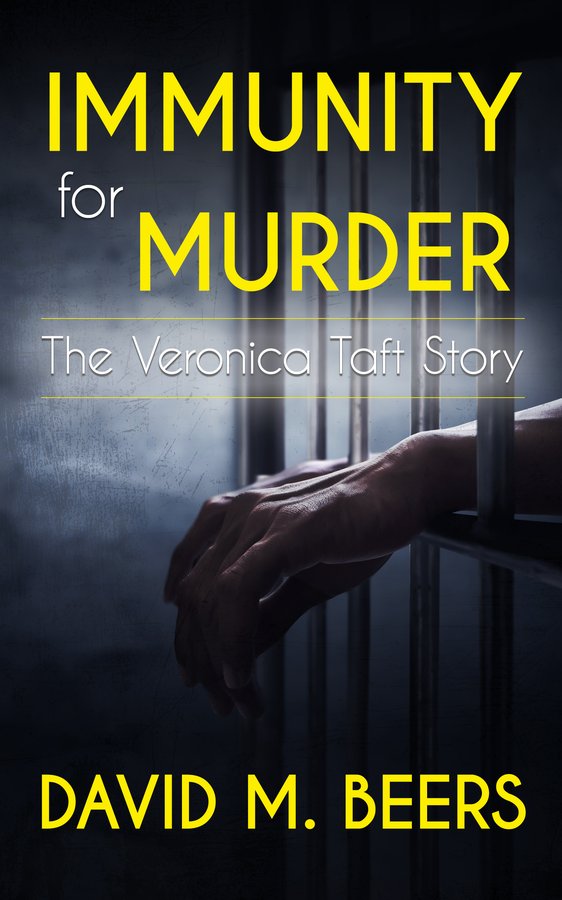
'Immunity for Murder' The Veronica Taft Story
by David M Beers
MOST TIMELY THEME BOOKY
Takes you to this book's Amazon page.
The judge's reasoning
Immunity for Murder earns its Booky on the strength of its moral argument and the raw documentary power of what it presents. Beers, writing from the perspective of a seasoned investigator, constructs a damning case not just about what happened to 2½-year-old Lyric Taft, but about how a system — police, prosecutors, CPS — can assemble momentum toward the wrong conclusion and then refuse to reverse course. The thesis is pointed: an innocent woman was convicted while the likely perpetrator walked. That argument is not abstract here; it is built brick by brick from interview transcripts, evidence logs, and procedural critique.
The book's most striking achievement is its use of Charles Pratt's unguarded phone calls from the interrogation room. Beers lets the transcript do the work — Pratt's shifting tenses around Lyric's death ("her son just passed away" before the official pronouncement; "he may have died when I was watching him"), his immediate call to arrange an attorney, his repeated insistence "it was on my watch" — accumulate into something a closing argument could never quite replicate. The author's interjections are economical and pointed, flagging missed forensic opportunities (no photos of Pratt's bloody knuckles, no fingernail scrapings) without lecturing.
The emotional weight of the dedication — Lyric Lonell Taft, June 2, 2008 – December 30, 2010 — sets a tone the book largely honors: grief channeled into accountability rather than sentiment. The subtitle The Veronica Taft Story makes a promise about advocacy, and the substance delivers on it.

Judged by Eleanor "Nell" Whitcombe — Literary Fiction · Prose & Style
"A sentence either earns its breath or it doesn’t."
Supporting passages
"Surprisingly, no photographs were ever taken of Chucky's fingernails or bleeding knuckles. Nor were any scrapings taken from under his fingernails. From experience, I found it very strange how they could simply overlook such elementary yet important tasks. A valuable opportunity lost."
This brief authorial interjection encapsulates the book's central argument — systemic failure through overlooked basics — with the precision of a seasoned investigator rather than an advocate, lending the critique credibility.
""Yo, the nigger not moving, son. The nigger's lips is purple, son. The niggers face and body start feeling mad warm, and cold. You feel me? So, I'm like, whoa, what the fuck is going on, son.""
Pratt's verbatim phone transcript — preserved in full vernacular as the author explicitly commits to — creates an immediacy and self-incriminating texture that no paraphrase could replicate, and it is the book's most powerful evidentiary tool.
"He got to be okay, yo. He got to be okay. It was on my watch. It was on my watch."
Pratt alone in the interrogation room, unobserved, produces the book's most quietly devastating line — its ambiguity (guilt? grief? fear?) doing more work than pages of analysis could.
Per-axis rubric scores
Every Booky-winning book is scored across all ten craft axes. The award category comes from the top axis; a second axis at or above 75 appears as secondary recognition.
Find out what your book does best.
Submit your book today. Get a real, honest, category-specific Booky — or every dollar back.
Submit Your Book → Screen Another Book