BookyAwards · 2026
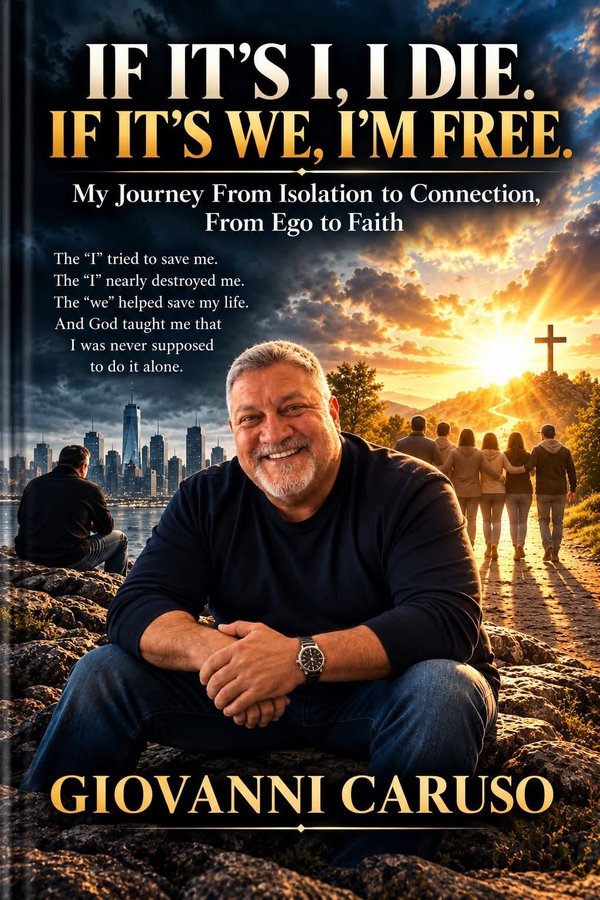
If it’s I, I die, if it’s we, I’m free
by Giovanni Caruso
Most Emotionally Generous Booky
Retailer link provided by the author.
The citation
The judge's reasoning
A good self-help book changes one specific thing about your week, and Caruso's does it with a text message. In Chapter 2, he wakes sober for years, with nothing wrong in his life, and feels an overwhelming urge to "destroy everything I had built." He drives toward the liquor store, says a bargaining prayer ("God, if You're there, You're going to have to figure out a way to stop me"), and a friend texts, "How are you doing?" He passes four liquor stores while talking and arrives home with the obsession gone. That scene is the book's thesis made concrete: the distance between relapse and recovery can be a phone call. The title's "If it's I, I die; if it's we, I'm free" is not a slogan here; it is a lived experience.
The other earned moment is the one that opens the book: his five-year-old son coming downstairs and seeing him inebriated. Caruso reads that look as a role reversal, the frightened child as his own inner child, and himself as "the demon." It is honest, unflattering, and specific, and it makes the surrender in Chapter 1 believable rather than doctrinal.
The book is strongest where it distinguishes things the reader can act on: sobriety versus recovery, taking responsibility versus taking blame, acceptance versus giving up, and the four-question check ("Am I being angry? Truthful? Selfish? Afraid?") for moments of anger. Chapter 11 distills this into a usable checklist. Caruso's gift is the plainspoken credibility of someone who has lived what he teaches and never claims to have arrived. For readers in or near the rooms of recovery, this is a warm, practical companion.
From the book
Supporting passages
"Sometimes the distance between me and a relapse is not a mile, a meeting, or some grand spiritual revelation. Sometimes it's a prayer and a text message from a friend who simply asks, "How are you doing?""
"I saw myself in him. I saw my inner child. I saw a frightened little boy being tormented by something scary. In that moment, it became almost like a role reversal in my mind. I was the demon. I was the addiction. And he was me."
"Sobriety, as I understand it, is the absence of the drink or the drug. Recovery is what happens when I begin doing the work to change the person who used them as a solution."
The scorecard
Per-axis rubric scores
Every Booky-winning book is scored across all ten craft axes. The award category comes from the top axis; a second axis at or above 75 appears as secondary recognition.
- Prose & Style 71
- Characterization 74
- Dialogue 60
- Plot & Structure 74
- World-Building 79
- Originality 70
- Emotional Resonance AWARDED 82
- Theme & Substance SECONDARY RECOGNITION 80
- Genre Execution 80
- Marketability & Hook 76
Scores out of 100
Find out what your book does best.
Submit your book today. Get a real, honest, category-specific Booky — or every dollar back.
