
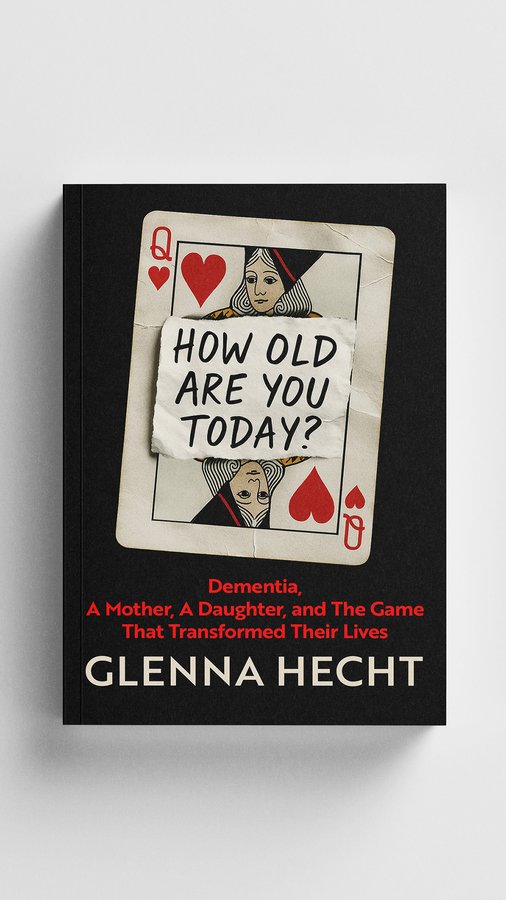
How Old Are You Today? Dementia, A Mother, A Daughter, and The Game that Transformed Their Lives
by Glenna Hecht
BEST EMOTIONAL BUILD BOOKY
Takes you to this book's Amazon page.
The judge's reasoning
Hecht earns her strongest notes in the moments she refuses to sand down her own failures. The book opens not with sentiment but with avoidance — an only child who "took a job across the country to get away from my mother" — and that admission buys credibility for everything that follows. The Stars of David scene is the standout: a mother covering her hospital room in blue ink, and instead of treating it as tragedy, Hecht reframes it through the doctor's eyes as expression — "This isn't destructive. This is expressive." That's a genuinely earned turn, not a manufactured one, and it sets up the book's real thesis: that dementia caregiving can be reframed as connection rather than only loss.
The age-reveal chapter does similar work with lighter tools — the Social Security call revealing her mother shaved five years off her age for decades, met with a shrug and a giggle — and Hecht lets the moment be funny without undercutting the grief sitting underneath it. That tonal range, moving from the angels-and-synagogue delusion scene to slapstick ("Do you think I'm pregnant?") to the flat gut-punch of a support-group stranger saying relief only comes "when they die," is the book's real achievement. Hecht's refusal to accept that line — "I wouldn't do that... I wanted to fight for what was still there" — is the emotional spine the whole memoir hangs its practical game framework on, and it reads honest rather than aspirational.
The prose is plain and occasionally over-explains its own feelings, but the material and the candor about her ambivalence toward her mother carry it.

Judged by Arthur Beaumont — Non-Fiction · Memoir · Business · Self-Help
"A good non-fiction book changes one specific thing about your week."
Supporting passages
"This isn't destructive. This is expressive. And she's not the only one who's ever tried to draw her way through the dark."
The doctor's reframe of the Stars-of-David scene captures the book's central emotional pivot from horror to meaning.
"There's no magic fix. But there is a choice in how you face it. And that choice? That's everything."
States the book's practical thesis directly, earned by two chapters of failed research and support groups.
"So? What's a few years." And then she giggled. No confession. No backstory. No drama. Just a shrug and a laugh."
A small, specific detail that renders the mother as a distinct, willful person rather than a symbol of illness.
Per-axis rubric scores
Every Booky-winning book is scored across all ten craft axes. The award category comes from the top axis; a second axis at or above 75 appears as secondary recognition.
Find out what your book does best.
Submit your book today. Get a real, honest, category-specific Booky — or every dollar back.
Submit Your Book → Screen Another Book