BookyAwards · 2026
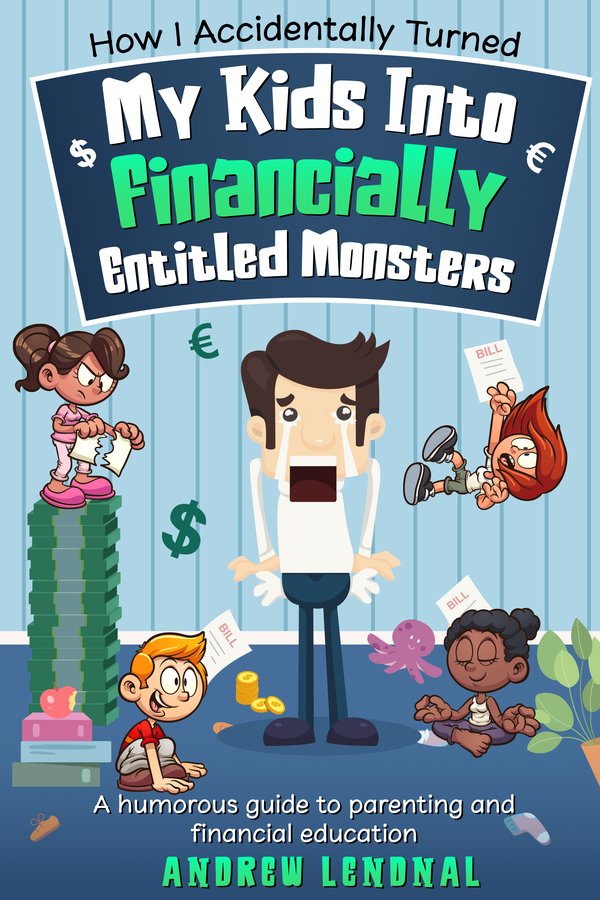
How I Accidentally Turned My Kids Into Financially Entitled Monsters
by Andrew Lendnal
Most Practical Self-Help Booky
Retailer link provided by the author.
The citation
The judge's reasoning
A good non-fiction book changes one specific thing about your week, and this one is built to do exactly that. Lendnal's real accomplishment is architectural: twenty-five chapters, each split into a conceptual framing and a practical application, running from the origin of entitlement ("The Myth of Easy Money") through allowance, credit, gifts, investing, budgeting, charity, entrepreneurship, digital money, college, parental anxiety and sibling dynamics, before closing on an appendix of resources. A parent can open to any chapter and walk away with a Friday-night activity. That is genre execution done right.
The suggestions are concrete and kid-sized: the three-jar "Spend, Save, Share" system; handing a child a fixed grocery budget and letting them weigh organic against generic; the "Product Wars" family debate; a monthly family budget meeting with snacks; a virtual $1,000 stock portfolio tracked on the fridge. The credit-card explanation, "borrowing a pencil from a friend, but agreeing to return it with a shiny cap as a thank-you," is exactly the register a ten-year-old can follow.
The title promises a confessional, funny memoir of parental failure, a strong hook that sells itself on a bookstore shelf. The dedication (to Melanie, Angelina, Juliette and Arielle, and the line about "turning our family into a financial case study") hints at a personal story the chapters mostly don't tell. That is the book's clearest opportunity: more of the family's own flubs, with names and numbers, would give the strong structure the personality its title advertises. As it stands, it is a dependable, warm, usable family-finance playbook.
From the book
Supporting passages
"Imagine borrowing a pencil from a friend, but agreeing to return it with a shiny cap as a thank-you. The shiny cap is like the interest on a credit card: it's the fee for the privilege of borrowing."
"Assign each a purpose: saving, spending, and sharing. Giving tangible homes to these abstract ideas makes the concept of money real."
"Ever caught yourself in a grocery store, perplexed, as Junior drops a $10 box of cereal into the cart, confidently declaring, "We can just swipe the card!"?"
The scorecard
Per-axis rubric scores
Every Booky-winning book is scored across all ten craft axes. The award category comes from the top axis; a second axis at or above 75 appears as secondary recognition.
- Prose & Style 72
- Characterization 62
- Dialogue 60
- Plot & Structure 77
- World-Building 68
- Originality 70
- Emotional Resonance 70
- Theme & Substance 78
- Genre Execution AWARDED 80
- Marketability & Hook SECONDARY RECOGNITION 79
Scores out of 100
Find out what your book does best.
Submit your book today. Get a real, honest, category-specific Booky — or every dollar back.
