
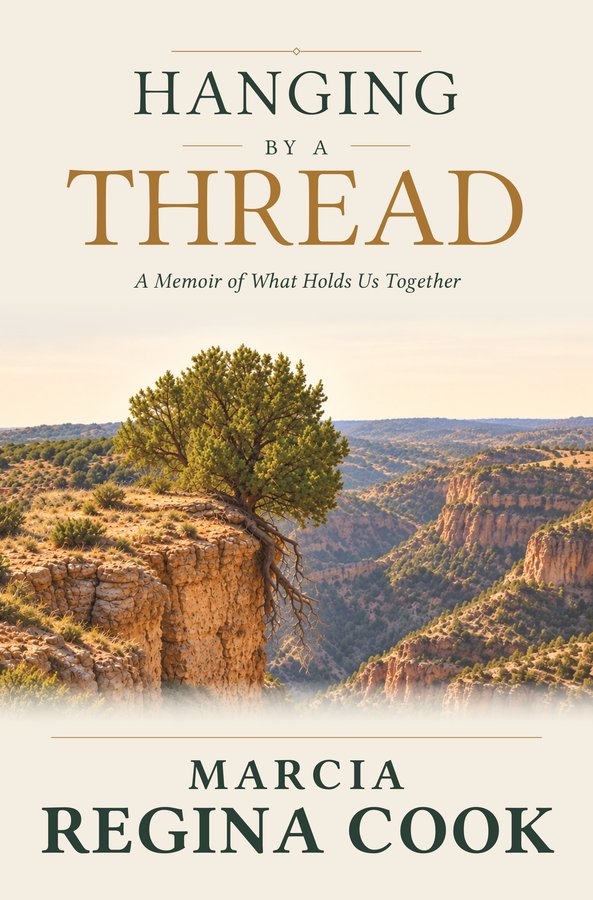
Hanging by a Thread
by Marcia Regina Cook
BEST SUBCULTURE PORTRAIT BOOKY
The judge's reasoning
Cook builds rural Brazil so precisely that the sensory record does the argument's work for her. The jaguar at the road's entrance, the boat motors that "grew and faded without the boat ever coming close," the green-flowered curtain standing in for a door — these aren't decorative. They're how the book earns its central claim, that a life can be held together by small, unglamorous threads rather than one dramatic rescue. The image of Mom carrying water uphill, or building a shade shelter from branches "because there is no proper shelter to give," turns ordinary domestic labor into the book's real argument about love: not the power to remove hardship, but the determination to find one drier place inside it.
The orange-tree scene is the strongest set piece in this excerpt — a five-year-old hiding from her grandfather's stick among thorns she can predict, refusing to trust a closed door. Cook doesn't rush the resolution; she lingers on the physical cost ("For hours they had gripped bark and branches") before the banana Mom offers, unprompted, before even tending the scratches. That sequencing — hunger addressed before harm is assessed — is the book's clearest thesis in miniature, and Cook trusts the reader to see it without underlining it twice.
The introduction runs long and occasionally over-explains sentiments the scenes have already delivered (the thread metaphor gets restated more than it needs to), which is where the prose loses some tautness. But the chapters recover: dialogue is sparse and functional rather than a strength, yet the lived textures of Mato Grosso and the house by Rio Verde are rendered with real authority, never anthropologized or exoticized. This is memoir doing its most essential job — making a specific, vanished world legible to a stranger.

Judged by Arthur Beaumont — Non-Fiction · Memoir · Business · Self-Help
"A good non-fiction book changes one specific thing about your week."
Supporting passages
"Frogs, crickets, owls, horses, bats, passing boats, and sometimes gunfire traveled through the night as though the house were listening with me."
A single sentence that renders the porousness of the house and the child's hyper-attentive fear without a wasted word.
"Before washing the scratches, before examining every place the thorns had marked me, she gave me a banana... That order of care is what made an ordinary banana unforgettable."
The specificity of sequence — feeding before tending — carries more emotional weight than any abstract statement about maternal love could.
Per-axis rubric scores
Every Booky-winning book is scored across all ten craft axes. The award category comes from the top axis; a second axis at or above 75 appears as secondary recognition.
Find out what your book does best.
Submit your book today. Get a real, honest, category-specific Booky — or every dollar back.
Submit Your Book → Screen Another Book