
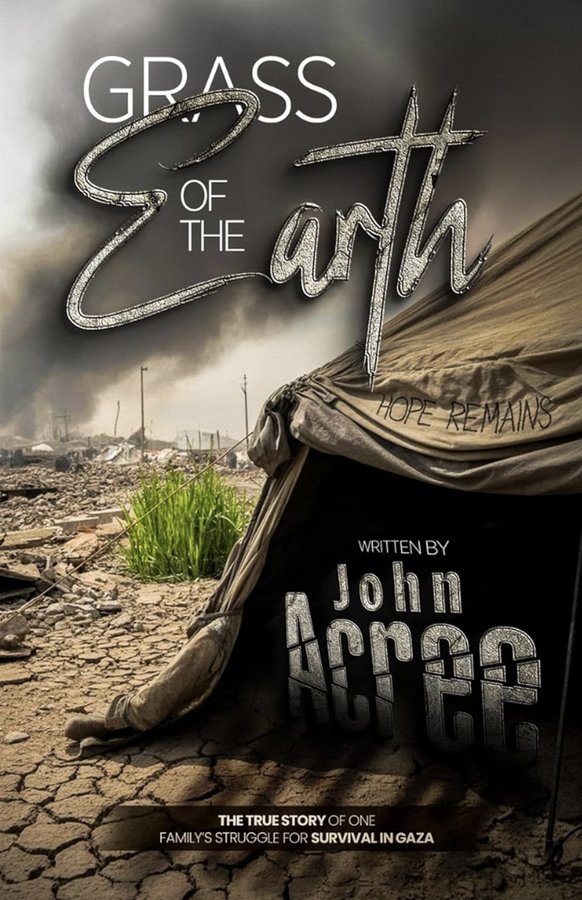
Grass of the Earth
by John Acree
MOST IMMERSIVE PROSE BOOKY
Takes you to this book's Amazon page.
The judge's reasoning
Grass of the Earth earns its Booky on the strength of prose that consistently does what war testimony rarely manages: it finds the precise image that refuses to generalize. John Acree writes in a register that is neither journalistic detachment nor activist heat—it occupies a rarer middle ground, lyrical without being precious, devastated without being sentimental. The sentence-level work is genuinely distinguished. Consider: "His wife's hand stayed on the child's shirt even in sleep, fingers hooked like a clasp." Or this, from Chapter 4: "I reached for my mother with the reflex of a son and felt her neck dislike me under my hand." These are not decorative—they are load-bearing. They carry the weight of people trying to remain human inside catastrophe.
The book's architecture is more uneven—it shifts between first-person immersion (the unnamed survivor's voice in Chapter 1), a third-person omniscient narrative following Omar in Chapter 2, and a near-documentary register in Chapter 3—but Acree earns this structural restlessness because each mode serves a different kind of witness. The mosaic of testimonies (May, Noa, Avidor, Hersh) operates like embedded journalism and gives the narrative a texture no single perspective could achieve.
The emotional resonance is most acute in the small, specific: the boy kicking a flattened water bottle "like a heart practicing"; the father who "put two mouthfuls of rice in his own mouth and then put the spoon into his child's because love is math you don't complain about." This is a book that earns its grief by refusing easy catharsis. It insists you stay in the room.

Judged by Arthur Beaumont — Non-Fiction · Memoir · Business · Self-Help
"A good non-fiction book changes one specific thing about your week."
Supporting passages
"He lay on the tile and counted not hopes but bodies: one, two, three, four. He does not count himself at such times because it feels greedy."
This restrained, devastating turn—the father's refusal to include himself in the count—exemplifies the book's ability to locate moral weight in syntactic economy.
"A man staggered past me carrying what I thought was a bundle of laundry. It had a little hand. He said her name like he was asking permission to be alive."
The pivot from 'bundle of laundry' to 'a little hand' is one of the most quietly devastating image turns in the manuscript, and the following sentence transforms grief into something metaphysically precise.
"The basil two streets away would die, and he would carry its smell in his hair as defiance."
The recurring basil plant becomes the book's most effective material symbol—the ordinary domestic world that the war destroys—and this line crystallizes its meaning without over-explaining it.
Per-axis rubric scores
Every Booky-winning book is scored across all ten craft axes. The award category comes from the top axis; a second axis at or above 75 appears as secondary recognition.
Find out what your book does best.
Submit your book today. Get a real, honest, category-specific Booky — or every dollar back.
Submit Your Book → Screen Another Book