
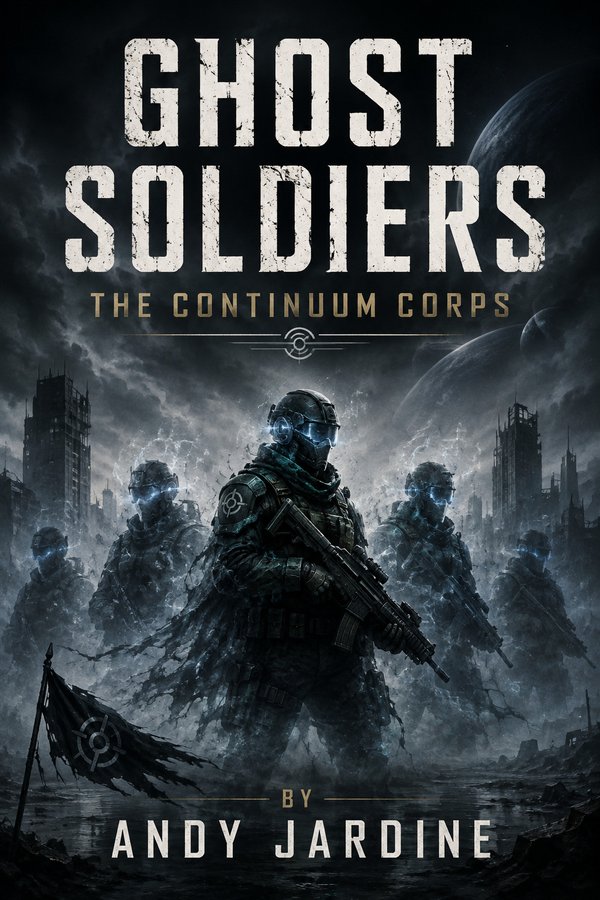
Ghost Soldiers: The Continuum Corps
by Andy Jardine
BEST ALTERNATE HISTORY BOOKY
Takes you to this book's Amazon page.
The judge's reasoning
The strength here is conceptual scaffolding: Andy Jardine has assembled a genuinely interesting premise — soldiers plucked from the brink of death across radically different eras (a WWI tunneller, a cybernetic 22nd-century marine, a medieval scout, a resistance fighter from a Nazi-victory timeline, an intelligence officer from a Britain that "never existed") conscripted into a temporal-repair corps. That's a strong hook, and the Pale Command / Necropolis Engine conspiracy gives the book a spine worth following.
The trouble is execution at the sentence level. The prose leans hard on abstraction and repetition rather than earned specificity — "fragile web," "delicate thread," "fractured," and "haunted" recur so often they lose weight, and entire paragraphs of interiority (Callum's trauma, Lira-9's identity crisis, Wilfred's erased Britain) are essentially re-narrated three or four times across the opening chapters with only cosmetic variation. The reader meets Callum's mustard-gas trauma in "Echoes of War," then again nearly verbatim in "Echoes of the Past," then again in "Shadows of War" — the same beat, restated rather than deepened. This is a structural problem more than a stylistic one: the manuscript circles rather than advances for long stretches before the actual first jump.
Where it does work is in the premise's thematic ambition — the preface's insistence that "every choice ripples through the fragile web of timelines" is a real philosophical question, and the moment the intelligence officer says "are we heroes, or harbingers of chaos?" gestures at something the book clearly wants to sit with. That's worth rewarding, even if the prose hasn't yet learned to trust a shorter sentence.

Judged by Eleanor "Nell" Whitcombe — Literary Fiction · Prose & Style
"A sentence either earns its breath or it doesn’t."
Supporting passages
"We are Ghosts, called from the edges of collapse and death, stitched into a single purpose—to guard the Continuum, the threads of time itself."
A clean articulation of the Corps' premise that gives the concept immediate shape and stakes.
"Is survival worth the erasure of others? Does preserving one timeline justify sacrificing countless alternate realities?"
States the moral engine of the book directly, showing the author knows what question the story is meant to interrogate.
Per-axis rubric scores
Every Booky-winning book is scored across all ten craft axes. The award category comes from the top axis; a second axis at or above 75 appears as secondary recognition.
Find out what your book does best.
Submit your book today. Get a real, honest, category-specific Booky — or every dollar back.
Submit Your Book → Screen Another Book