
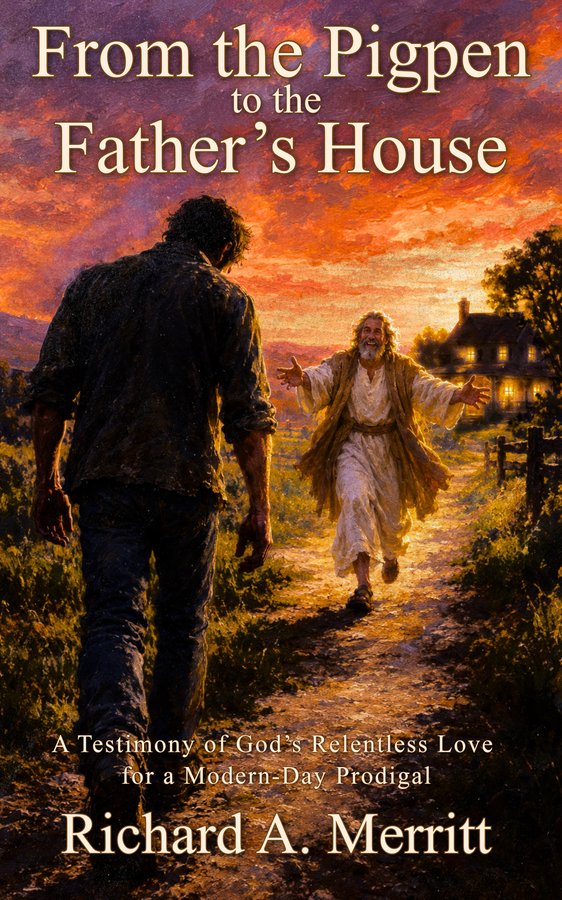
From the Pigpen to the Fathers House
by RICHARD MERRITT
BEST TREATMENT OF FORGIVENESS BOOKY
Retailer link provided by the author.
The judge's reasoning
Merritt's book has a real argument, and it is the parable of the prodigal son, applied to one man's actual life. The title names the thesis, the early chapters plant its seeds, and the final chapters pay it off. What makes it work is that he refuses to excuse himself. Chapter 20 includes a passage in which he retracts his own earlier explanation: "I drank because it was the only time I could escape Vietnam (an excuse, but maybe a good one)... that's just nonsense! There is no excuse for dishonoring my parents and rebelling against God." Few memoirists revise their own alibi on the page.
The structure of that argument runs through the book. The buried box of photographs at nine, the alley magazines at fifteen, the "little peek" in Colorado Springs and the 2019 deliverance are laid out as one sixty-year thread. He doesn't hand over a cleaned-up redemption either. Chapter 32 follows his freedom with Kathi's question, "Are you the man I thought I married or was everything, from the very beginning, just an act?", and with his admission that forgiveness "didn't take away the deep hurt."
The emotional high points are earned by restraint. He cries in an airport bathroom stall because of his father's face, not because of Vietnam. He doesn't dramatize Joe's death or the day his children left Phoenix, and the plain telling lands harder for it. The book also gives a reader something to use: the pornography chapters, the betrayal-trauma explanation and the closing resource list will change one specific thing about a reader's week. The comic Arizona childhood, the Mustang errand and the Taipei elevator races keep the book from reading as penance.

Judged by Arthur Beaumont — Non-Fiction · Memoir · Business · Self-Help
"A good non-fiction book changes one specific thing about your week."
Supporting passages
"I drank because it was the only time I could escape Vietnam (an excuse, but maybe a good one)."
The author later retracts this line outright in the same chapter, a rare moment of a memoirist auditing his own self-justification.
"When my flight was delayed, I sat in a bathroom stall for a half hour crying—not because I was leaving for Vietnam, but because of the pain I saw in my Dad's eyes."
The tears are placed where an ordinary war memoir would not place them, and the detail carries the father-son relationship without commentary.
"Secret sins don't go away. Guilt will eventually turn into a lifetime of shame, and shame has no mercy."
The thesis is stated at age nine, after the neighbor's fence burns, and the rest of the book tests it.
Per-axis rubric scores
Every Booky-winning book is scored across all ten craft axes. The award category comes from the top axis; a second axis at or above 75 appears as secondary recognition.
Find out what your book does best.
Submit your book today. Get a real, honest, category-specific Booky — or every dollar back.
Submit Your Book → Screen Another Book