
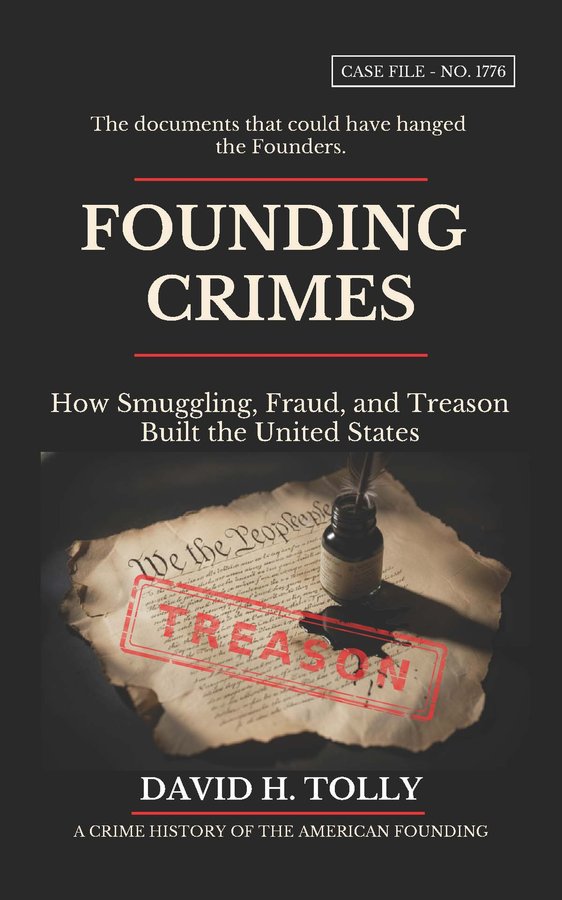
FOUNDING CRIMES How Smuggling, Fraud, and Treason Built the United States: The Documents That Could Have Hanged the Founders. A Crime History of the American Founding
by David Tolly
MOST PERSUASIVE CASE BOOKY
The judge's reasoning
Tolly's real achievement here is structural argument, not decoration. The book's thesis — 'a founding is not a moment, it is a crime that succeeded' — is stated cleanly and then actually carried through twenty-seven documents in causal sequence, each one 'answering the last one's question and asking the next one's.' That's a genuine argument with a testable spine, not a theme bolted on after the fact.
What earns it real credit is the discipline around evidence. He flags Somerset v. Stewart as 'this book's most contested chapter' and marks the pre-emptive-defense-of-slavery thesis as a live scholarly dispute rather than settling it for drama. He kills the Hancock-signature myth outright ('a marvelous story with no contemporary source... We leave it on the shelf') even though it would have been the easiest crowd-pleaser in the chapter. That's a forensic accountant's habit applied to history, and it's rarer than it should be in popular non-fiction.
The prose backs the argument up with real music — the repeated 'the charge is,' the reckonings that 'cut both ways,' the closing line 'Genius and rot, the same page, the same hand' doing double duty as both verdict and refrain. The Samuel Adams portrait ('a hole in his pocket... he could organize discontent') is a small, vivid character sketch built entirely from a documentary record, which is the hardest kind to pull off.
Where it thins out is dialogue (there isn't much, by design) and emotional interiority — this is argument-driven history, not memoir, and it reads that way. But for a reader who wants their founding myths checked against the record and handed back sharper, this delivers exactly what it promises on the cover.

Judged by Arthur Beaumont — Non-Fiction · Memoir · Business · Self-Help
"A good non-fiction book changes one specific thing about your week."
Supporting passages
"A founding is not a moment. It is a crime that succeeded."
The book's organizing thesis, stated with the clarity of a legal charge and then actually sustained across the manuscript.
"Genius and rot, the same page, the same hand. That is not a contradiction to be explained away. That is the founding, exactly as it was."
Characteristic cadence — short declaratives building to a hard, unresolved conclusion, the book's rhetorical signature.
"Every document in this book could have hanged the men who wrote it."
A one-line hook that reframes familiar national scripture as evidence in a capital case, tailored perfectly to the 250th-anniversary market moment.
Per-axis rubric scores
Every Booky-winning book is scored across all ten craft axes. The award category comes from the top axis; a second axis at or above 75 appears as secondary recognition.
Find out what your book does best.
Submit your book today. Get a real, honest, category-specific Booky — or every dollar back.
Submit Your Book → Screen Another Book