
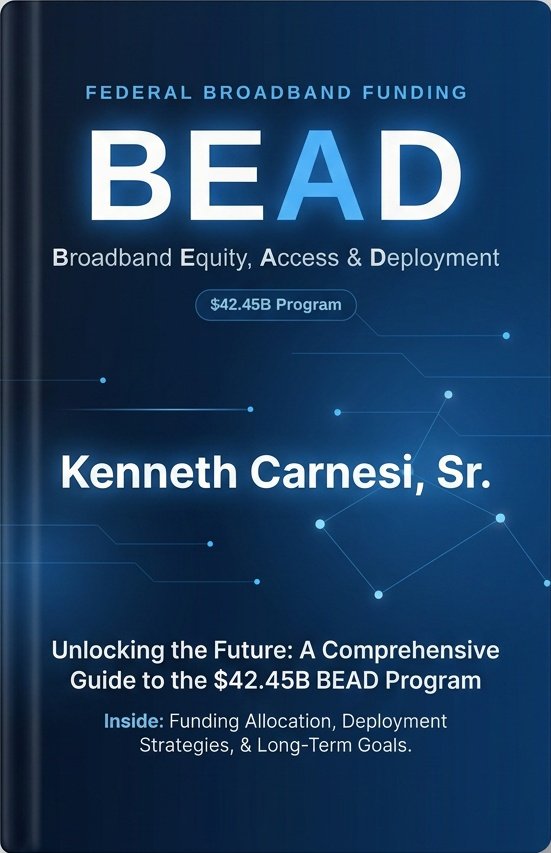
Federal Broadband Funding- BEAD- Broadband Equity, Access, & Deployment
by Kenneth Carnesi, Sr.
BEST TREATMENT OF POWER BOOKY
The judge's reasoning
This is a niche how-to book that knows exactly who it's for and doesn't waste their time getting there. Carnesi's core substance claim — that BEAD is a three-layer funding stack (federal sets rules, state distributes, local executes) and small vendors need to position at the local layer before the RFP drops — is a real, actionable argument, not a vibes-based motivational pitch. The river-and-irrigation-lines metaphor ("You don't negotiate with the reservoir") is the kind of plain-language translation device that actually earns its keep for a reader who has, as the book itself puts it, "read three paragraphs of regulatory language and closed the tab."
The book's strongest structural move is repeatedly distinguishing what a vendor shouldn't do (chase NTIA directly, wait for the formal solicitation) from what actually works (help the county IT director interpret the state's program manual months before the grant is even awarded). The recurring hypothetical vendor scenarios — the 41-year-old Midwest MSP owner, the six-person shop owner who spends two hours walking a city IT director through technical specs and becomes "the only vendor who already has a relationship" — are clearly signposted as illustrations rather than case studies, which is honest, but they do the job of making an abstract procurement chain feel concrete and winnable.
Where the book earns its Genre Execution credit is in its refusal to pad: it names specific statutory sections (60102), specific dollar figures by state, specific technical thresholds (25/3 vs 100/20 Mbps), and closes each section with genuinely executable next steps ("go to broadbandusa.ntia.gov... this takes fifteen minutes"). For a reader who's a technician first and a businessperson second, that's exactly the right register.

Judged by Arthur Beaumont — Non-Fiction · Memoir · Business · Self-Help
"A good non-fiction book changes one specific thing about your week."
Supporting passages
"Stop thinking of BEAD as a government grant you're trying to get a piece of. Start thinking of it as a long-term business development opportunity that happens to be funded by the government."
A genuine reframe with practical consequences, not a platitude — it changes what the reader should actually do next.
"Think about it like a river system. The federal government is the reservoir at the top. The state broadband office is the main channel... And the vendors are the people doing the actual farming."
A clean, memorable analogy that translates a genuinely confusing funding structure into something a busy MSP owner can retain and act on.
"The vendors who help municipalities get funded are almost always the ones hired to execute the project."
This is the load-bearing strategic claim of the book, built up methodically across two chapters before being stated this plainly.
Per-axis rubric scores
Every Booky-winning book is scored across all ten craft axes. The award category comes from the top axis; a second axis at or above 75 appears as secondary recognition.
Find out what your book does best.
Submit your book today. Get a real, honest, category-specific Booky — or every dollar back.
Submit Your Book → Screen Another Book