
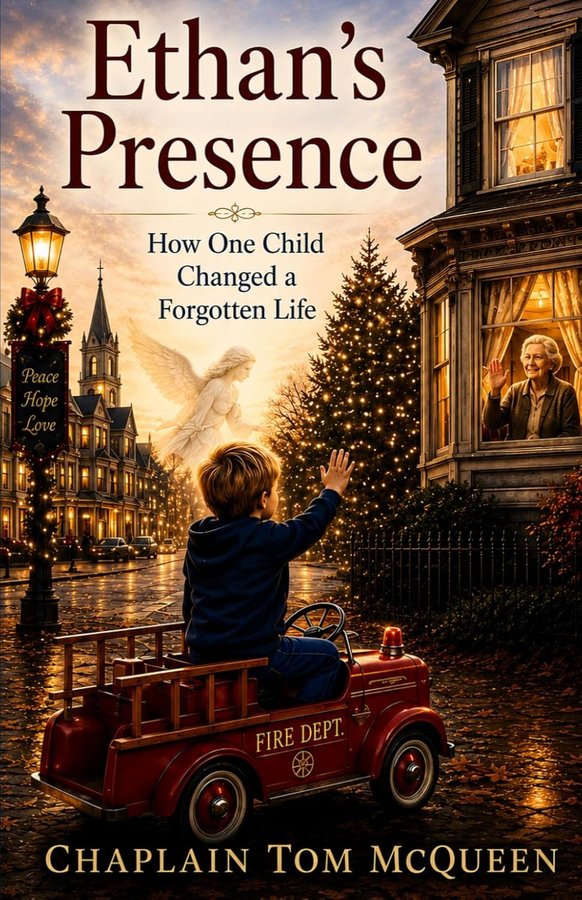
Ethan's Presence - How One Child Changed A Forgotten Life
by Chaplain Tom McQueen
MOST MOVING MOMENT BOOKY
The judge's reasoning
Chaplain Tom McQueen's Ethan's Presence earns its breath most fully in the emotional architecture it builds around Anna Miller — and then dismantles, tenderly, with a five-year-old's outstretched arms.
The book's great structural gamble is spending the bulk of its opening chapters constructing fifty years of loneliness before a kindergartner even appears on the page. That gamble pays off. By the time Ethan drags that green garbage can across Highland Avenue, we feel the weight of it — because McQueen has made us live inside Anna's Tuesday-morning grocery trips, her cancelled Christmas tree, the carolers who walk past her door without stopping. These are not melodramatic gestures. They are the small, accumulating indignities that make the final scene's "genuine smile that reached her eyes" land with a force entirely disproportionate to its simplicity.
The characterization is consistently above the workmanlike level. Anna is rendered with real interiority — the 1995 painting of Chuck, hung and then buried in the basement under a sheet, is the kind of specific, earned detail that separates memoir-adjacent literary nonfiction from sentiment. Sarah Thompson's interlude confession — "I know she didn't pull the trigger. I know she was grieving too ... But I needed someone to blame" — is honest in a way that invites the reader's self-examination rather than their easy sympathy. Robert Chen's neighbor perspective, shaped by his own experience of racialized blame, adds a layer of structural empathy that prevents the book from becoming a simple redemption fable.
The prose is plain but purposeful, and occasionally it finds a genuinely fine register: "grief and rage and confusion needed somewhere to go ... the blame to settle like ash on Anna Miller's shoulders." That image earns its place. So does Matt Thompson's dying thought about the Big Dipper — "seven stars arranged in the shape of a ladle, hanging in the northern sky like a promise that some things stay constant even when everything else changes" — which is more affecting than a lesser writer would dare to make it.
This is a book that does exactly what it intends: it makes the reader feel, without manipulation, what it costs a community to choose blame over witness — and what it costs one woman to absorb that choice for half a century.

Judged by Eleanor "Nell" Whitcombe — Literary Fiction · Prose & Style
"A sentence either earns its breath or it doesn’t."
Supporting passages
"Then she heard them walk past her house without stopping. She'd taken the tree down the next morning and never put one up again."
Two sentences that accumulate fifty years of loneliness into a single wordless gesture — the compression here is where the book's emotional intelligence is most visible.
"She took the painting down. She carried it to the basement. She covered it with a sheet and never looked at it again. After that, she stopped trying."
Anna's burial of her own best work — and the one-sentence epitaph McQueen appends — is the most precise and unsentimental portrait of defeated interiority in the manuscript.
"My anger was just grief with nowhere to go. And by then, Anna had been living in that house alone for so long that I don't think anyone in Madison even remembered why we'd stopped talking to her. We just knew we didn't."
Sarah Thompson's confession articulates the book's central argument about communal blame with the credibility of a witness who participated in the harm she's describing.
Per-axis rubric scores
Every Booky-winning book is scored across all ten craft axes. The award category comes from the top axis; a second axis at or above 75 appears as secondary recognition.
Find out what your book does best.
Submit your book today. Get a real, honest, category-specific Booky — or every dollar back.
Submit Your Book → Screen Another Book