
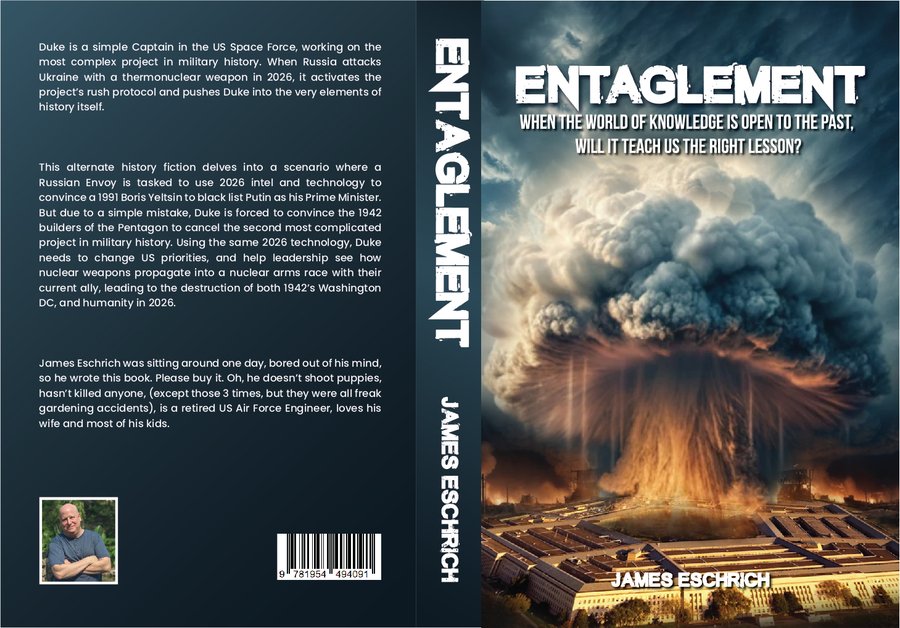
Entanglement
by James Eschrich
MOST UPLIFTING READ BOOKY
The judge's reasoning
Entanglement builds its time-travel thriller on a premise that has real teeth: two iPads quantum-entangled across eighty-four years, so that a nuclear strike on the 2026 Pentagon becomes a thermal bomb under the 1942 Pentagon. Eschrich uses that mechanism to turn the genre's usual paradox-fretting into a ticking clock, and it makes every scene in 1942 matter to someone in 2026.
The book's strongest asset is feeling. Duke Duchni is a PTSD-scarred Space Force captain with a stuttering breathing exercise ("in two seconds, out four... Alexis") that the author keeps returning to at the right moments: in the dark lab after the date-reset catastrophe, on the front steps of the War Department, in the hospital bed. Colonel Reed's fatherly grief over his lost son Thomas, and the slow-burn Duke/Alexis romance that the whole office has bet on, give the geopolitical stakes a human center. The Al-Asad flashback (Chapter 6) is the best sustained writing in the book; the ringing ears, the ammonia stink, and the way Duke volunteers to stay behind so Tech Sergeant Taylor can go home to his daughters show us exactly who this man is before the premise tests him.
The finale is where the book earns its recognition. Duke's last message to Colonel Reed, cut off mid-sentence by the thermal event, followed by the life-review in which he finally sees his father's love for what it was, is a genuinely moving payoff for the abandonment wound planted in the opening chapters. The coda that loops back to the lab corridor, with Duke finally asking Alexis out and the whole office cashing in on the pool, resolves the emotional line with warmth and a wink.
The prose is plain and the dialogue sometimes over-explains, but the structure, the stakes, and the sincerity carry it. This is a heartfelt, propulsive entry in military sci-fi.

Judged by Eleanor "Nell" Whitcombe — Literary Fiction · Prose & Style
"A sentence either earns its breath or it doesn’t."
Supporting passages
"Duke breathed in through his nose for two seconds and out of his mouth for four. As Duke applied those skills, his chest calmed, breathing slowed, and shaking stopped."
A recurring coping ritual grounds Duke's PTSD in concrete, repeatable detail rather than telling us he is traumatized.
""So if alpha’s in 2026 and beta’s in 1991, what would happen to beta when alpha evaporates?" "beta would evaporate.""
The entanglement mechanism is laid out plainly and then weaponized into the book's central ticking clock.
"Sergeant Givens’ waist and legs toppled and spilled their contents near Lieutenant Colonel Nichols"
The climactic phase misalignment pays off an earlier 'what if someone is only partially in the phase' setup with grim, memorable force.
Per-axis rubric scores
Every Booky-winning book is scored across all ten craft axes. The award category comes from the top axis; a second axis at or above 75 appears as secondary recognition.
Find out what your book does best.
Submit your book today. Get a real, honest, category-specific Booky — or every dollar back.
Submit Your Book → Screen Another Book