
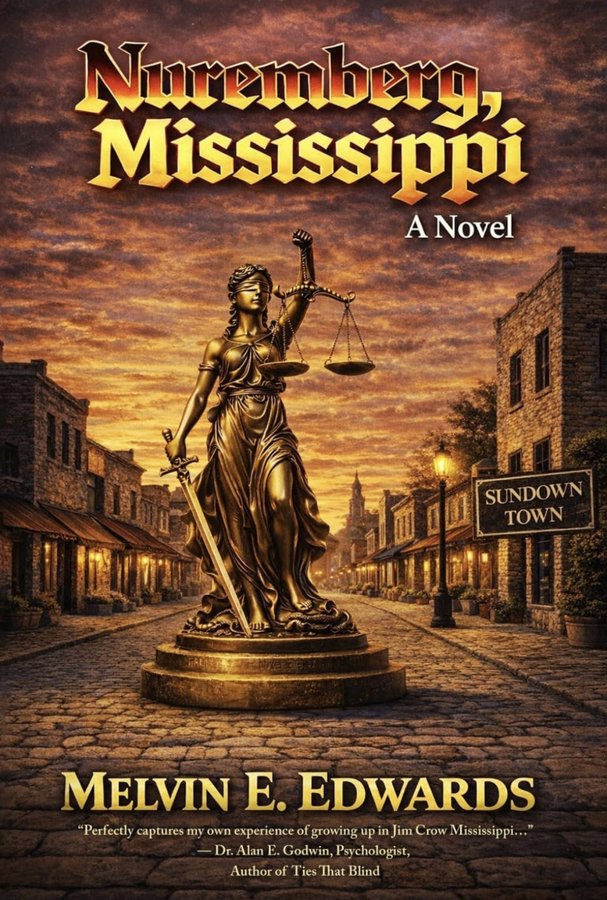
Nuremberg, Mississippi
by Melvin E. Edwards
BEST TREATMENT OF FRIENDSHIP BOOKY
The judge's reasoning
Nuremberg, Mississippi earns its breath sentence by sentence, and its thematic architecture is the engine that drives everything else.
Edwards is doing something structurally audacious: the fractional chapter numbering — "Three and One-Fourth," "Three and One-Half," "Three and Three-Fourths" — is not a stylistic affectation. It mirrors the bureaucratic increment by which Henry Logan is slowly dismantled. The form is the argument. When a man's life is parceled out in fractions by a system that never fully charges him, never fully convicts him, just endlessly subdivides his margin until the margin is gone, the chapter headings become the novel's most devastating commentary.
The Hosea Jones scene in Chapter Two is a masterclass in showing how legality launders harm. The prosecutor's word "demonstrative" lands like a stone, and Silas circling "optional" in his notes — with its echo of the judge's language — is precisely the kind of quiet, earned moment that separates literary fiction from polemic. Edwards trusts the reader to do the moral arithmetic.
The exchange between Henry and Silas about James Baldwin — "He's angry" / "Maybe not. But neither does pretending things are orderly when they're only controlled" — dramatizes the novel's central tension without ever letting either man become a mouthpiece. Silas's complicity is sympathetic precisely because it is so recognizable: the man who uses the system's own tools, believes he is being reasonable, and cannot yet see what his reasonableness costs.
The young clerk in Chapter Three and Three-Fourths — fired for processing a permit correctly — is the book's first genuine gut-punch, and Edwards delivers it in a single flat sentence. That restraint is the prose at its best.

Judged by Eleanor "Nell" Whitcombe — Literary Fiction · Prose & Style
"A sentence either earns its breath or it doesn’t."
Supporting passages
"The sentence didn't demonstrate excessiveness in any particular aspect. Each component stood within discretion. All of it could be defended."
This is the novel's thesis compressed into three sentences — the mechanism by which systemic harm sustains itself through the appearance of procedural correctness.
"The older signs demanded allegiance. The newer ones feign detachment. They allow the town to insist it has changed while preserving the same result. A warning is still issued. A boundary is still drawn. Only the tone has softened, as if Southern manners might redeem cruelty."
The rhythm here — declarative, then damning — is exactly the controlled austerity that gives this novel its moral authority without tipping into sermon.
""I'm not asking you to feel better," Henry said. "I'm asking you to help me make it visible.""
Henry Logan's clarity in this moment — neither beseeching nor performing — is the fullest expression of a character whose discipline is his form of resistance.
Per-axis rubric scores
Every Booky-winning book is scored across all ten craft axes. The award is given on the top axis (or top two for premium tiers).
Find out what your book does best.
Submit your book today. Get a real, honest, category-specific Booky — or every dollar back.
Submit Your Book → Screen Another Book