
Eclipsed System
by Ruth Wong
MOST BELIEVABLE FUTURE BOOKY
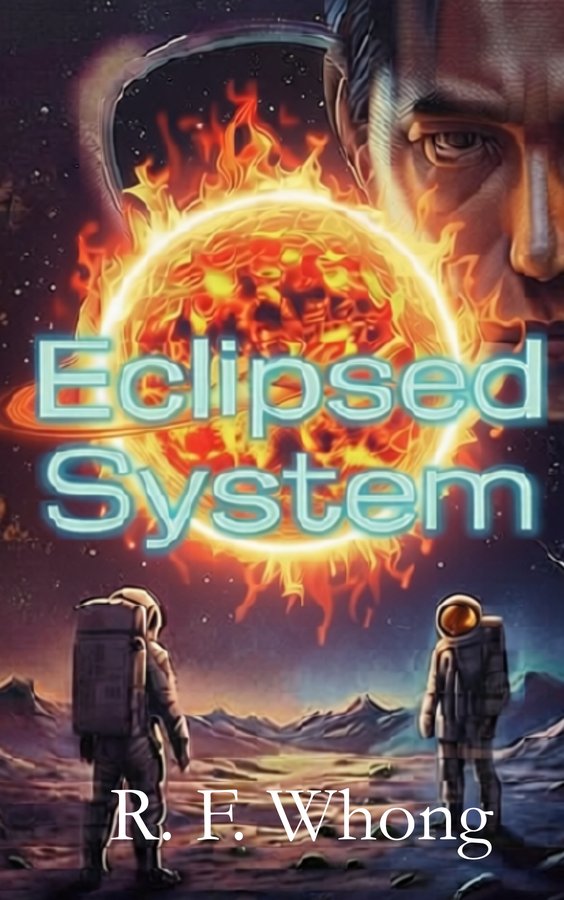
The judge's reasoning
Wong (writing as R.F. Whong) does something unusual for a sci-fi manuscript: she builds a plausible, textured near-future without stopping to explain it. The reader is dropped into 'low-functionality mode,' 'Amber status,' and 'the belt' the way a resident of New Vegas would experience them — sideways, in motion, through friction rather than lecture. That decision to let jargon accrue meaning through use (the elevator's 'flashing amber lights,' Travis's forced sixteen-flight descent) is the strongest structural choice in these opening chapters, and it pays off in the novel's best image: the Eternal Day's fake sky peeling back mid-council-meeting to reveal 'the real star' that 'tugged at hearts like a physical weight.' That single moment — Sato's controlled room breached by an uncontrollable sun — does more world-building work than the glossary ever could.
The theme of surveillance-as-mercy runs consistently under the plot, most sharply in Sato's line: 'Sometimes that's mercy. Sometimes it's cowardice. Help me tell which it is.' That's a genuinely interesting moral hinge for a Christian SF novel to hang its antagonist on, rather than making him a cartoon.
The prose itself is uneven — some sentences reach for lyricism and land flat ('Same road, different mileage') while others earn their keep ('Frost feathered along the seam where heat and cold found each other'). Dialogue leans expository, especially in the council scene, but the Travis/Laura reunion has real emotional weather — the annotated grief message, the unspoken confession — that gives the ideas a human hook.

Judged by Eleanor "Nell" Whitcombe — Literary Fiction · Prose & Style
"A sentence either earns its breath or it doesn’t."
Supporting passages
"Overhead, the Eternal Day—the man-made sky—slid open to reveal a hard, piercing blue. The Sun hung there, ancient and close enough to touch."
The counterfeit sky's rupture makes the novel's central conceit — a controlled society confronting an uncontrollable cosmos — physically visible in a single image.
""Sometimes that's mercy. Sometimes it's cowardice." Sato tilted his head. "Help me tell which it is, and I'll help you keep your friends alive.""
Frames the novel's surveillance-state antagonist through a genuine ethical ambiguity rather than easy villainy.
""I couldn't figure out how to be in the room with your grief from a quarter million miles away.""
A quiet, specific admission of emotional cowardice that lands harder than the novel's bigger set pieces.
Per-axis rubric scores
Every Booky-winning book is scored across all ten craft axes. The award category comes from the top axis; a second axis at or above 75 appears as secondary recognition.
Find out what your book does best.
Submit your book today. Get a real, honest, category-specific Booky — or every dollar back.
Submit Your Book → Screen Another Book