BookyAwards · 2026
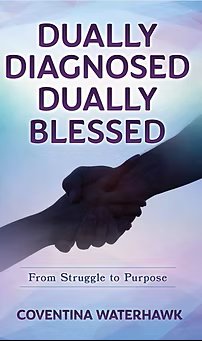
Dually Diagnosed Dually Blessed: from Struggle to Purpose
by Coventina Waterhawk
Best Treatment of Freedom Booky
The citation
The judge's reasoning
A good non-fiction book changes one specific thing about your week. This one hands you a ten-minute list of them.
Waterhawk's memoir opens with a plain, unflinching sentence: "I wanted to die when I was seven years old." From there she narrates a life without self-pity or polish: manicuring scissors on her wrists, a first drunk at her cousin's wedding that felt like "magic," a psychiatrist who told her the symptoms were "situational, not chemical," and a hospital discharge with "no medication or any follow-up counseling." Her honesty about her own failures is what earns trust. She names the custody losses, the tow-truck assault, and the dog thrown off a balcony, and she doesn't launder any of it.
The substance is where the book wins. The Coping Methods chapter is the real product: ice in the hand during a crisis, opposite action, radical acceptance applied to a driver cutting you off, mindfulness while washing your hands, a rubber band snapped on the wrist to mimic cutting. She is also careful about medication, writing that "only you and your psychiatrist can determine" what works. The elemental invocation is a distinctive, usable ritual.
The choice to widen the book with contributors, among them a therapist confessing professional stigma, a Navy veteran with a service dog, and a psychologist drawing comics to survive PTSD, turns one woman's memoir into a field guide for the dually diagnosed. The book's weakness is its prose, which is plain and occasionally repetitive, and the later chapters vary in polish. But its purpose, its practicality, and its willingness to say the hard thing make it a book a struggling reader could actually use.
From the book
Supporting passages
"During a crisis, I can distract my attention and do something else, usually by holding an object or a substance like ice."
"I was released back into the world with no help. So, I tried to smile and be funny, but inside, I wanted to disappear forever."
"I felt like I was going to die if I expressed my feelings to him, so I kept the mental and emotional torture to myself for months."
The scorecard
Per-axis rubric scores
Every Booky-winning book is scored across all ten craft axes. The award category comes from the top axis; a second axis at or above 75 appears as secondary recognition.
- Prose & Style 66
- Characterization 77
- Dialogue 58
- Plot & Structure 78
- World-Building 79
- Originality 76
- Emotional Resonance SECONDARY RECOGNITION 81
- Theme & Substance AWARDED 82
- Genre Execution 80
- Marketability & Hook 77
Scores out of 100
Find out what your book does best.
Submit your book today. Get a real, honest, category-specific Booky — or every dollar back.
