
Devil's Chandalier
by Debra Hopkins
MOST INVENTIVE FORM BOOKY
Retailer link provided by the author.
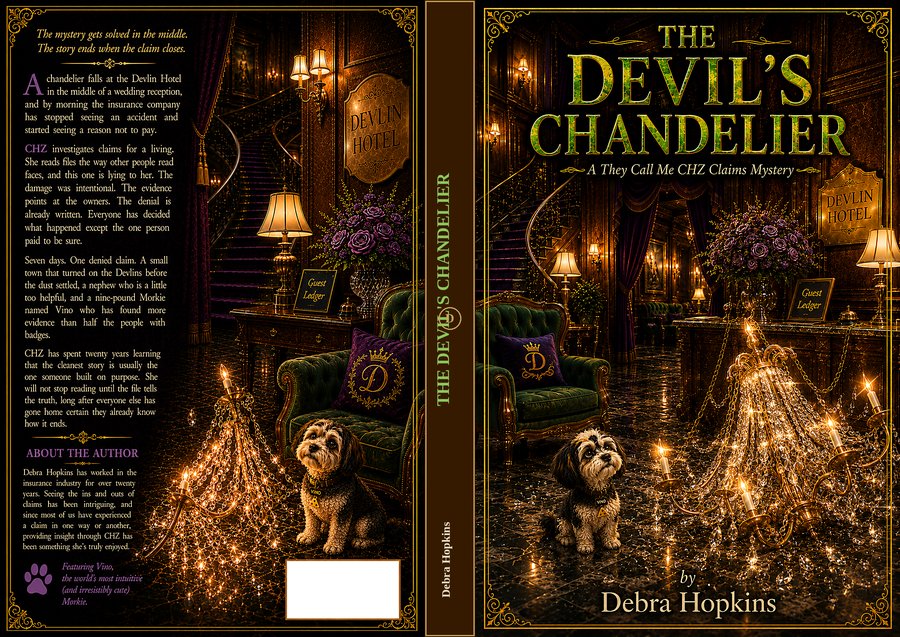
The judge's reasoning
Plot is promises kept, and this book keeps its central one: the insurance file is the crime scene. Most cozy mysteries ask who held the knife. The Devil's Chandelier asks who benefits if the denial stands, and then builds a seven-day countdown, a coverage memo, and a reversal letter into a genuinely satisfying climax. I haven't read a whodunit that made a reservation-of-rights letter feel like a ticking clock.
The prologue is the strongest opening in the book. Margaret counting 347 crystals on a ladder, the chandelier sighing at 8:47, Barlow's face changing after he climbs down. Setup that pays off. The final turn, where Connor predicts the exact phrase "intentional acts" eleven hours before the denial exists, is a clue planted in plain sight and cashed in cleanly. Also well built: the revised schedule that kept guests in the lobby, Russell's wrong-schedule alibi, Rosa saying nobody asked what she saw, and Graham Bell as a convincing wrong answer before Connor reclaims the top of the board.
CHZ is a real character: Dr Pepper smuggled like contraband, steel-toe boots swapped for flip-flops, tripping on nothing, and a quietly sharp claims mind. Vino, Marlene, Luz, Rita and Margaret all feel lived-in. Rita's "I'm afraid it makes me late" scene is the emotional high point. Dialogue crackles, especially the Claire/CHZ banter.
Where it wobbles: the middle sags under repeated beats, the chandelier-adjacent comic business occasionally steps on tension, and some late chapters run long after the mystery is solved. Those are polish issues. The core idea is fresh, and the genre promise is delivered.

Judged by Marcus Thorne — Thriller · Mystery · Suspense · Commercial Fiction
"Plot is promises kept."
Supporting passages
"Financial pressure did not prove fraud. Knowledge of maintenance did not prove sabotage. Access did not prove use. Intentional damage did not identify the person whose intent mattered."
The claims-adjuster logic is the book's real detective method, and this passage makes a coverage letter read like a deduction.
"Connor Keane, somber and well-lit, had predicted both the denial and its exact vocabulary two days early."
A clean fair-play clue: the timestamp on the video is the kind of planted-then-paid-off detail that makes the final confrontation feel earned.
""I didn't want her carrying one more thing.""
Rita's confession of fixing Connor's messes quietly for years gives a supporting character a complicated, believable moral weight.
Per-axis rubric scores
Every Booky-winning book is scored across all ten craft axes. The award category comes from the top axis; a second axis at or above 75 appears as secondary recognition.
Find out what your book does best.
Submit your book today. Get a real, honest, category-specific Booky — or every dollar back.
Submit Your Book → Screen Another Book