
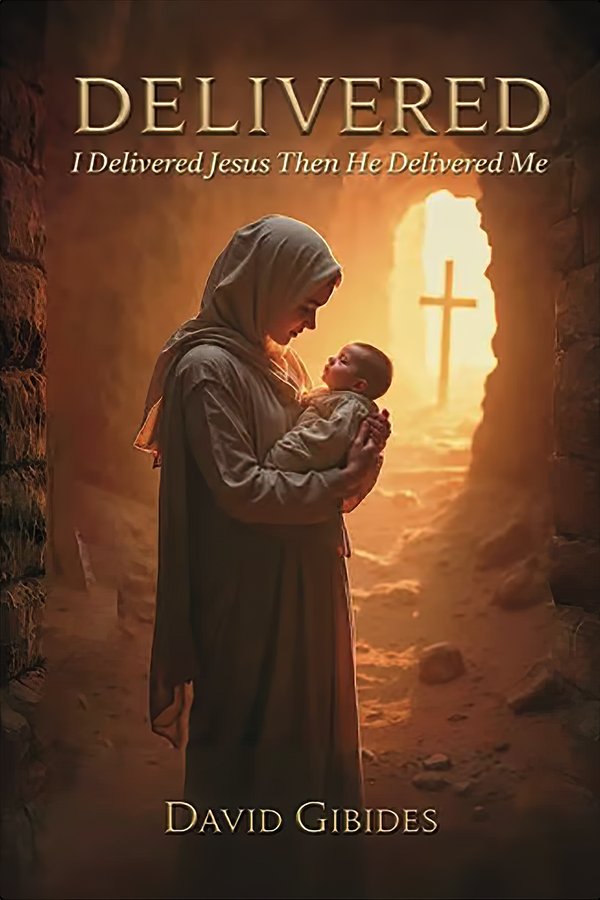
Delivered I delivered Jesus then He delivered me
by David Gibides
MOST HEALING READ BOOKY
Retailer link provided by the author.
The judge's reasoning
This is a book that earns its feeling by the plainest means: patience, and the courage to let a woman be angry at God for forty years before she is allowed to be healed.
The central invention is Saphira, a skeptic whose hands deliver the infant Jesus and whose family pays for His survival. That is a genuinely fresh angle on a story told ten thousand times, and Gibides never lets her off the hook. The Bethlehem massacre is the book's hardest passage, and it works because of restraint at the moment of horror. After the soldiers leave, Matthias "extended just one finger and touched the small tunic's edge" and the grief is carried by that single gesture. Mora laying out five pieces of bread instead of four lands with equal quiet force.
The long arc then earns its payoffs. The sapphire carried unsold through poverty and widowhood, Jonah's raising at Nain, and the touch of the fringe at Capernaum all rest on years of accumulated loss. When Jesus calls her "Daughter," it lands because the book has made us feel twelve years of exile. The reunion with Mary, with its honest exchange about why she fled, resolves the bitterness without cheapening it. Even the ending's insistence that her faith is "small, fragile, but enough" feels like the story's own conclusion rather than an imposed sermon.
The prose is serviceable rather than distinctive, and some scenes explain what they should trust the reader to feel. But the structure is sound, the theology is wrestled with rather than recited, and the emotional spine is real. For readers of faith-driven historical fiction, this delivers exactly what it promises, with weight.

Judged by Eleanor "Nell" Whitcombe — Literary Fiction · Prose & Style
"A sentence either earns its breath or it doesn’t."
Supporting passages
"Matthias... extended just one finger and touched the small tunic's edge. He drew it back with sorrow filling every part of his body."
The massacre's aftermath is conveyed through one small, withheld gesture rather than melodrama, which is exactly where the book's grief is most powerful.
"Sometimes Mora would lay out five pieces of bread instead of four, her hand hanging awkwardly over that empty spot at the table."
A domestic detail carries the whole weight of absence without a word of explanation.
"Faith is not the same as belief, Saphira. Faith is not about what you say with your mouth or think with your mind. Faith is what you do with your hands, your feet, your heart."
Naomi's reframing is the book's thematic hinge, giving the skeptic protagonist a believable path back toward trust without erasing her doubt.
Per-axis rubric scores
Every Booky-winning book is scored across all ten craft axes. The award category comes from the top axis; a second axis at or above 75 appears as secondary recognition.
Find out what your book does best.
Submit your book today. Get a real, honest, category-specific Booky — or every dollar back.
Submit Your Book → Screen Another Book