
DECISSION BEFORE CONSEQUENSES
by Dr Willem.D Adendorff
MOST RELEVANT READ BOOKY
Retailer link provided by the author.
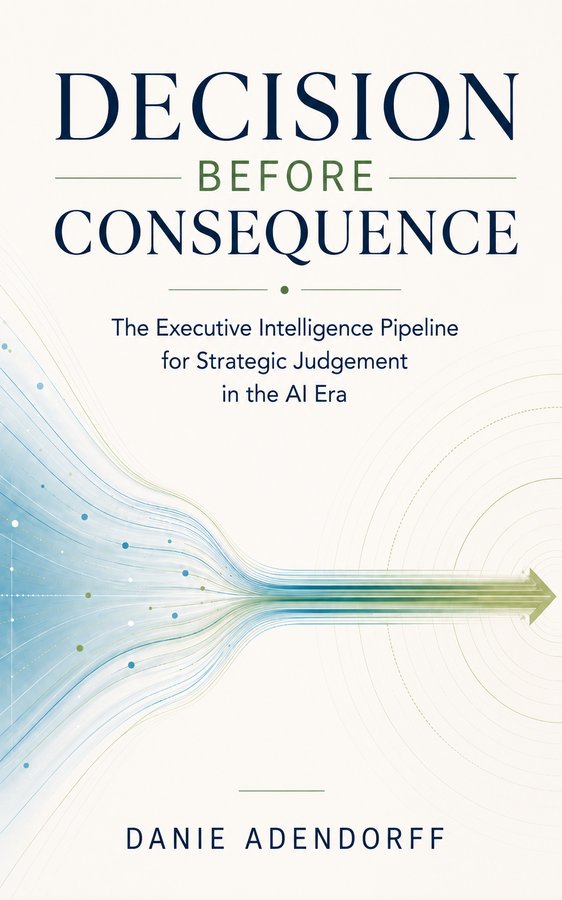
The judge's reasoning
This book makes a real argument and defends it for seventeen chapters: organisations do not fail for lack of information, they fail at conversion, the movement from signal to validated intelligence to accountable judgement to action and correction. The Executive Intelligence Pipeline (Signal → Validation → Interpretation → Escalation → Decision → Action → Adaptation) is a usable diagnostic, and the author applies it to a mid-career executive's actual week: ask which stage a piece of material is at before you let it shape a decision.
The strongest ideas earn their keep through practical distinctions. The F6-to-A1 grading chapter insists on separating source reliability from information credibility, and the line "Today's F6 is tomorrow's A1" guards against both dismissing weak signals and overstating them. The Human Return Point improves on vague "human-in-the-loop" language by forcing a named role, competence, evidence and accountable owner. The "distributed exposure" warning, that delegation without authority and protection is just risk pushed downward, is a sharp observation. Chapter 1's point that "the board is informed but not warned" frames governance failure memorably.
Structure is a major strength. Each chapter follows a consistent pattern of doctrine boxes, failure-mode tables and an executive diagnostic tool, and the chapters cumulate rather than repeat. The decision-laboratory chapter, with its before-the-verdict discipline and a Wendy's exercise that carefully avoids a founder-causality morality tale, shows methodological restraint.
The limits are real. The prose is doctrinal and repetitive, with the central pipeline restated many times. The book has few lived human stories, and its illustrative scenarios are explicitly synthetic. The central framework rests largely on the author's own synthesis. Emotional register is cool by design. But for its intended reader, it delivers a coherent, operational decision discipline.

Judged by Arthur Beaumont — Non-Fiction · Memoir · Business · Self-Help
"A good non-fiction book changes one specific thing about your week."
Supporting passages
"A report can confirm what occurred without revealing what is forming. A dashboard can display performance without interpreting significance."
This compresses the book's core thesis, that being informed is not being strategically aware, into two parallel sentences a reader can test against their own reporting.
"Distributed judgement requires authority, capability, information and protection to travel together. It is not legitimate to push risk downward while retaining ambiguity about authority, resources, escalation and accountability."
A principled, practical guard against empowerment rhetoric that quietly transfers exposure to junior staff.
"Boundary Conditions ask where the logic expires. Trade-Off Frontiers ask which sacrifice is being chosen before it does."
Shows how the chapters interlock as an argument sequence rather than a list of concepts, each discipline clarifying the one before it.
Per-axis rubric scores
Every Booky-winning book is scored across all ten craft axes. The award category comes from the top axis; a second axis at or above 75 appears as secondary recognition.
Find out what your book does best.
Submit your book today. Get a real, honest, category-specific Booky — or every dollar back.
Submit Your Book → Screen Another Book