
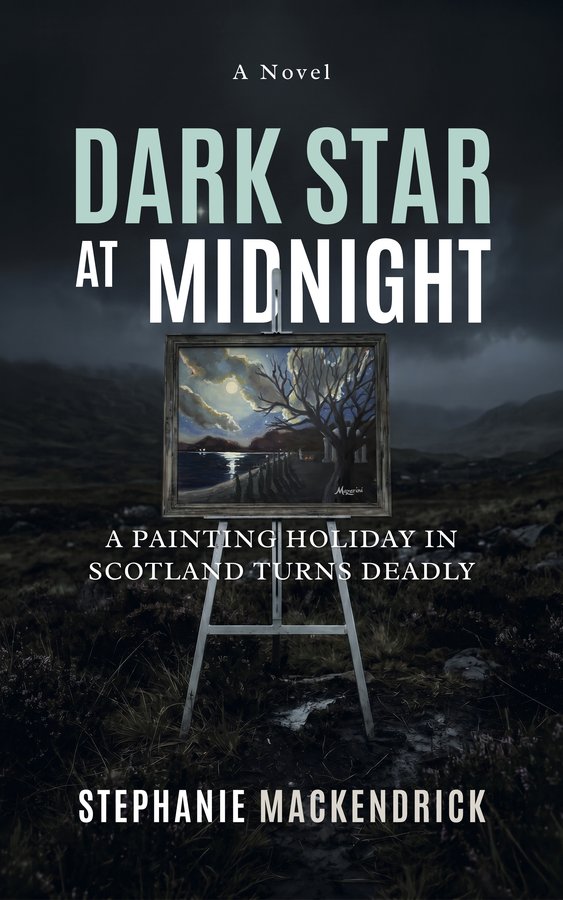
Dark Star at Midnight
by Stephanie MacKendrick
MOST IMMERSIVE SETTING BOOKY
Takes you to this book's Amazon page.
The judge's reasoning
MacKendrick's real strength here isn't the mystery engine — the Duncan Forbes disappearance is dispatched efficiently but sparingly in these opening chapters — it's the granular, lived-in rendering of Toronto's Riverside neighbourhood and its art society. The Taylor Building's history (the Don Valley Brick Works, the munitions manufacturing, the 1970s preservation fight) is delivered with a historian's specificity, and it pays off in texture: readers can see the exposed brick, feel the valley acting as "a wind tunnel for weather sweeping up from Lake Ontario." That same care extends to Cabbagetown's gentrification and the Summerhill Market's overpriced muesli — this is a writer who knows her city block by block, and it shows in every aside.
That world-building supports a genuinely strong ensemble. Isabel's arc from laid-off reporter to contented barista is quietly moving without melodrama ("Funny how life could take such surprising turns"), and Bob — introduced as pure comic bluster ("My dignity, for starters") — gets an unexpected late turn into interiority, wrestling with mortality and the discomfort of art forcing him to feel something. Elizabeth's unnamed dread, her buried Scotland memories, and the offshore account she "still felt guilty about" are planted with a light hand that promises a slow-burn payoff rather than a shock twist.
The mystery plot itself is thinner in this excerpt — MacInnes's investigation is competent police procedural but conventional, and the connective tissue between the Aberfeldy disappearance and the Toronto art society hasn't yet clicked into gear by chapter three. But the craft on display — dialogue that differentiates each artist's voice, a genuine sense of place, characters who feel like real, flawed adults — earns this book its recognition.

Judged by Marcus Thorne — Thriller · Mystery · Suspense · Commercial Fiction
"Plot is promises kept."
Supporting passages
"The exposed brick of the outer wall created a warm hodgepodge of orange, buff, and the occasional burnt slate-grey brick, contrasting with the neater brickwork on the exterior."
The physical texture of the converted Victorian factory is rendered with real specificity, grounding the ensemble scenes in a believable, lived-in space.
"He used to think this whole painting thing was a load of bollocks... Now he wasn't so sure."
Bob's shift from comic foil to a man quietly unsettled by mortality and feeling is earned through small, accumulating beats rather than exposition.
""Grow a pair." "I've got a fine pair, thanks very much, Jean.""
The banter between Bob and Jean gives each character a distinct comic rhythm and voice.
Per-axis rubric scores
Every Booky-winning book is scored across all ten craft axes. The award category comes from the top axis; a second axis at or above 75 appears as secondary recognition.
Find out what your book does best.
Submit your book today. Get a real, honest, category-specific Booky — or every dollar back.
Submit Your Book → Screen Another Book