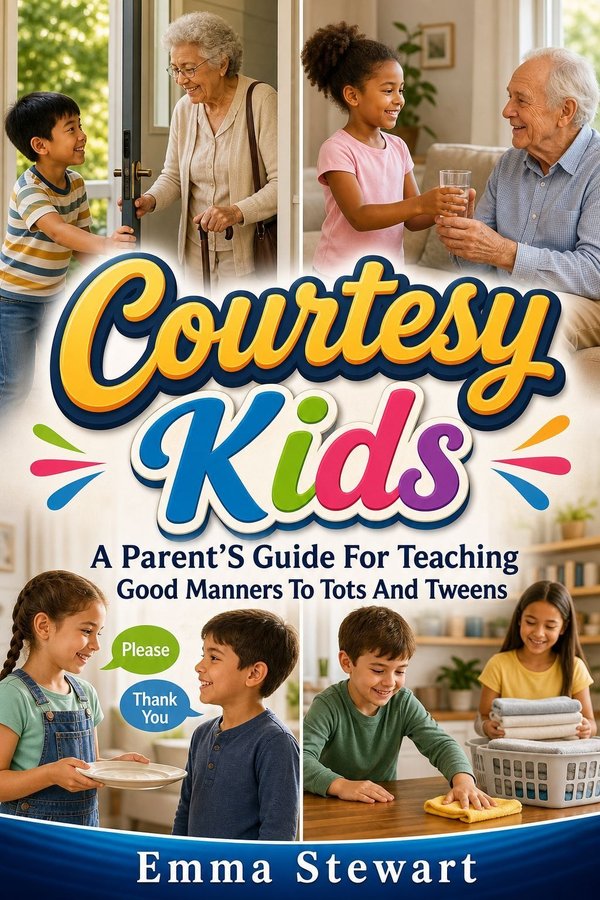
Courtesy Kids
by Emma Stewart
MOST THOUGHT-PROVOKING BOOKY
Takes you to this book's Amazon page.
The judge's reasoning
I read for sentences, and this book is not built of them — it's built of scaffolding, and to its credit, the scaffolding is sound. Stewart's real contribution here isn't a voice; it's an architecture. The age-banded breakdown (2-3, 4-5, 6-8, 9-12) gives an anxious parent something a vaguer manners book wouldn't: a place to land depending on which child is in front of them. The numbered "Rules" cheat sheet — model behavior, teach compassion, teach problem-solving, set expectations, set consequences, expect respect, teach patience — turns an abstract virtue ("be a kind family") into a checklist a tired parent can actually use at 7pm on a Tuesday.
The strongest moment of practical specificity comes in Rule Five, where the book resists the temptation toward vague punishment and instead ties consequence to context: 'if a child is not using polite words at the dinner table, a fitting consequence might be helping with cleanup—it's a natural consequence that directly relates to the setting where the manners were disregarded.' That's a real, transferable technique, not a platitude, and it's the kind of line a parent might actually use.
The prose itself is padded and repetitive — the same metaphors (sponges, seeds, oil in gears) recur so often they lose their charge, and whole paragraphs restate earlier ones almost verbatim. This is not a book that earns its sentences. But its organizing intelligence — age-appropriate, rule-based, cheat-sheet-friendly — is exactly what a busy parent reaching for a manners guide wants, and on that ground it delivers.

Judged by Eleanor "Nell" Whitcombe — Literary Fiction · Prose & Style
"A sentence either earns its breath or it doesn’t."
Supporting passages
"For instance, if a child is not using polite words at the dinner table, a fitting consequence might be helping with cleanup—it's a natural consequence that directly relates to the setting where the manners were disregarded."
A concrete, transferable technique rather than a platitude — the kind of specific takeaway that justifies the book's practical claim.
"During these transformative years, children start carving out their independence and testing boundaries. It is a crucial time for reinforcing the manners and behaviors that will shape them into considerate, respectful young people."
The age-stage structuring (here, Ages 9-12) is the book's organizing strength, giving readers a clear developmental roadmap typical of well-executed parenting guides.
Per-axis rubric scores
Every Booky-winning book is scored across all ten craft axes. The award category comes from the top axis; a second axis at or above 75 appears as secondary recognition.
Find out what your book does best.
Submit your book today. Get a real, honest, category-specific Booky — or every dollar back.
Submit Your Book → Screen Another Book