
BookyAwards · 2026
Continuity
by Brad Carroll
Best Treatment of Freedom Booky
Retailer link provided by the author.
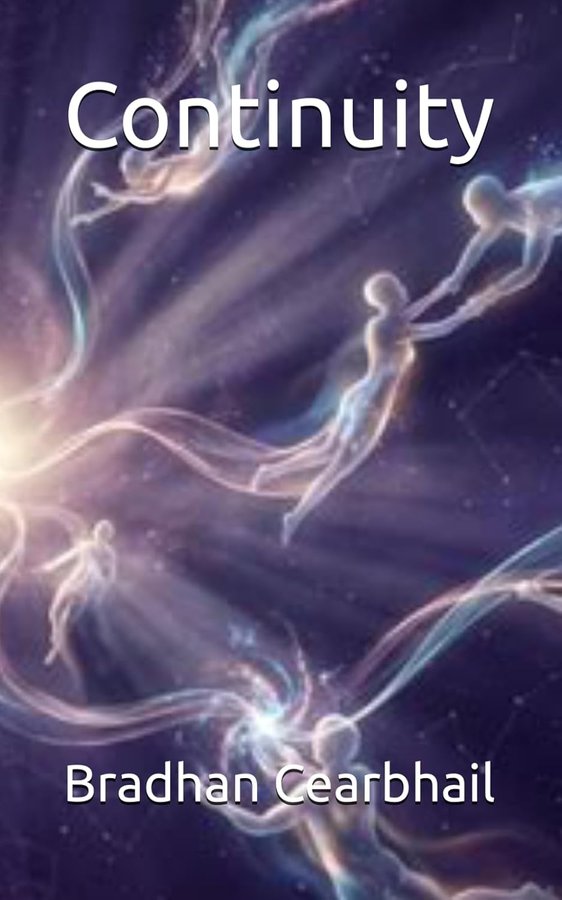
The citation
The judge's reasoning
Continuity is a book with a genuine question at its heart and the patience to follow it all the way out. Brad Carroll takes the oldest argument there is, what happens to us when we die, and sets it between two vocabularies that rarely get to speak civilly: the pew and the physics lab. Elias, the engineer who calls himself "on the fence with a notebook," and Lena, who trusts experience over models, are a married pair who never try to convert each other. Their kitchen conversations ("Religion says soul. Science says information. Maybe two dialects describing the same unknown?") plant the intellectual seed, and the book then actually tests it rather than letting it sit as decoration.
What earns this its recognition is how consistently the speculation serves the human stakes. The afterlife Carroll builds is not a reward-and-punishment ledger but a spectrum of coherence. Infants as faint sparks needing nurture, trauma-compressed minds, fragmented "predators of memory" that feed on loose recollection. Heaven and hell become states of awareness, which is both an old idea and, here, a freshly argued one. The Library of an extinct civilization and the galaxy slowly becoming a mind give the cosmology real scale, and the central tension, whether joining something vast means losing the self, is resolved through Lena's conviction that love is the structure that lets individuality and unity coexist.
The emotional spine holds: Lena's quiet "stay in the room," Elias's promise to "stay curious," and the closing insight that harmony does not erase the notes. The author's closing note, naming the quantum definition of a soul he is proposing, shows the book knows exactly what it is trying to say. That clarity of purpose is its strength.
From the book
Supporting passages
""You ever think," Lena said, "that people aren’t afraid of death itself so much as afraid of discontinuity? The idea that the story stops mid-sentence?""
"Heaven and hell, he reflected, were less places than conditions of awareness."
"Individuality had never been the opposite of unity. It was the foundation of it."
The scorecard
Per-axis rubric scores
Every Booky-winning book is scored across all ten craft axes. The award category comes from the top axis; a second axis at or above 75 appears as secondary recognition.
- Prose & Style 74
- Characterization 76
- Dialogue 73
- Plot & Structure 72
- World-Building 83
- Originality SECONDARY RECOGNITION 84
- Emotional Resonance 80
- Theme & Substance AWARDED 86
- Genre Execution 80
- Marketability & Hook 79
Scores out of 100
Find out what your book does best.
Submit your book today. Get a real, honest, category-specific Booky — or every dollar back.
