
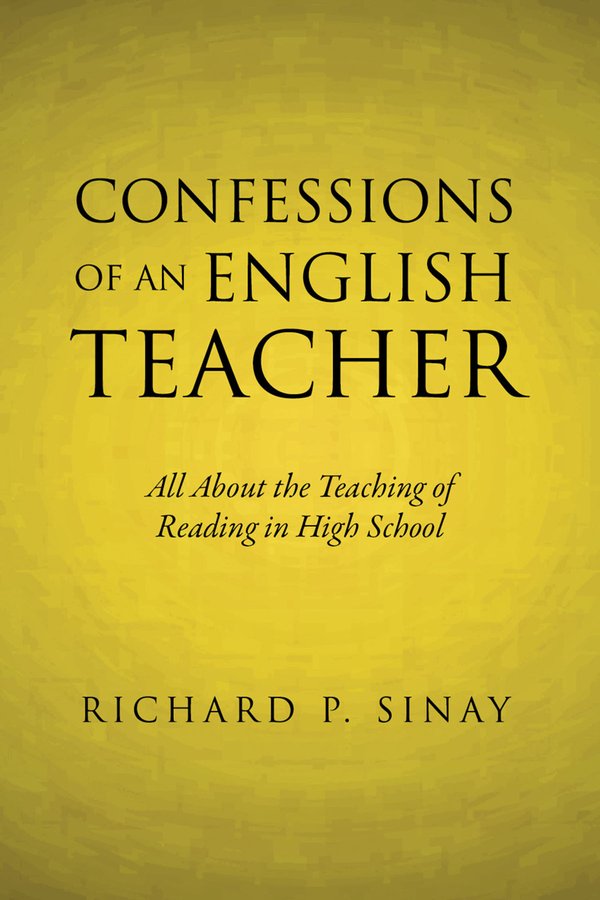
Confessions of an English Teacher
by Richard P. Sinay
BEST TREATMENT OF MEMORY BOOKY
The judge's reasoning
Richard Sinay has written a book with a single conviction and the stamina to argue it across eighteen chapters: that the English classroom exists to build literacy, and that reading, not the cultivation of "little literature lovers," is how that happens. The conviction is not borrowed. It comes from thirty-five years at the front of the room, a master's in reading alongside a master's in literature, and a personal history he is willing to put on the page.
That history is the book's strongest evidence. Sinay lists all thirty-two works he read at La Habra High School between 1962 and 1966, from The Iliad to Paradise Lost, and then describes teaching honors juniors in the 2000s who stole Huckleberry Finn quizzes rather than read it. The contrast is specific, checkable and a little startling. The senior-year Chemistry class is better still: an English teacher assigned to a subject he didn't know, reading quietly at the front while a sophomore reads the textbook aloud, and Sinay absorbing a dozen Steinbeck novels in the dead time. It is a small, funny, true scene that makes his case for independent reading better than any statistic.
The practical machinery is where the book earns its keep for a working teacher. He explains how to match students to books using the San Diego Quick Assessment and the Nelson-Denny, how to rate a 200-title classroom library as easy, medium or challenging, how to interview a student to confirm they finished a book, and why context vocabulary beats the Friday word-list quiz. His argument about readability and cultural suitability, such as Steinbeck for readers who will recognise his characters, is a clear position a reader can adopt or argue with.
It is a candid, opinionated, experience-driven book. Its arguments about frustration-level reading and the Title I reading lab his district never applied for carry real conviction.

Judged by Eleanor "Nell" Whitcombe — Literary Fiction · Prose & Style
"A sentence either earns its breath or it doesn’t."
Supporting passages
"The student gains literacy one step at a time, like climbing a step ladder."
The step-ladder image compresses the book's central pedagogical claim, that reading material should sit just above the reader's level, into a sentence a teacher can carry into the classroom.
"He told us he knew nothing about Chemistry, and so we would have to figure out what to do. He then sat there and started reading his book!"
A vivid, specific scene from Sinay's own schooling that makes his case for independent reading more persuasively than argument could.
"Teaching English is not about making students love literature; rather, it is about making them want to read."
A clear, provocative thesis that defines the book's audience and gives it a hook for working English teachers.
Per-axis rubric scores
Every Booky-winning book is scored across all ten craft axes. The award category comes from the top axis; a second axis at or above 75 appears as secondary recognition.
Find out what your book does best.
Submit your book today. Get a real, honest, category-specific Booky — or every dollar back.
Submit Your Book → Screen Another Book