
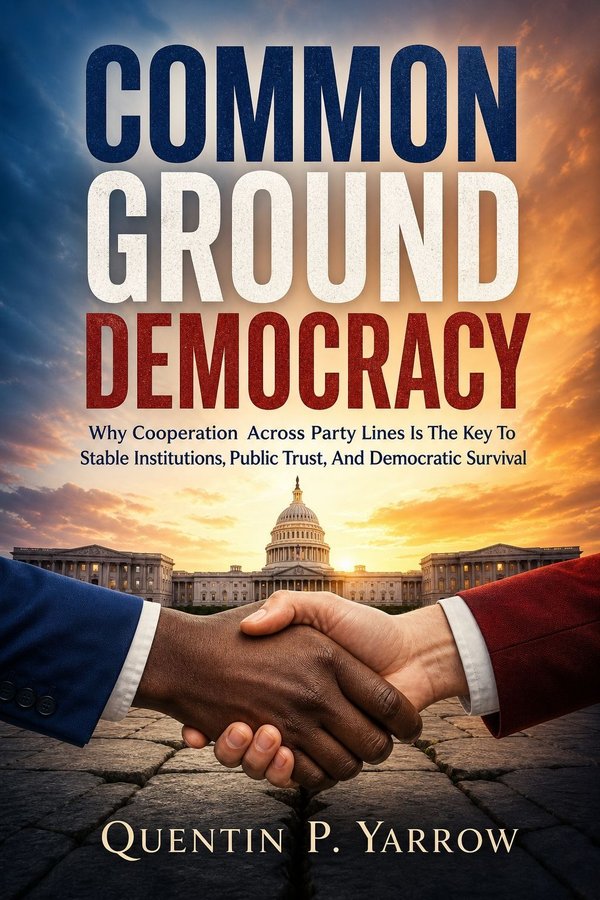
Common Ground Democracy
by Quentin P. Yarrow
BEST FIRST CHAPTER BOOKY
Takes you to this book's Amazon page.
The judge's reasoning
Judged as argument-structure rather than plot in the fictional sense, this book's real strength is architectural discipline. Yarrow builds his case in deliberate stages: the Introduction establishes that trust is 'not the sentimental trust that assumes everyone will act generously, but the ordinary civic trust' that procedures matter; Chapter 1 diagnoses the pathology (partisan identity overwhelming civic identity, gridlock as tactic rather than symptom); Chapter 2 pivots to prescription (common ground as 'method, not a slogan'); Chapter 3 supplies the mechanism, splitting interpersonal from institutional trust with a clean, testable distinction — 'Interpersonal trust without institutional trust can produce a politics of loyalty... Institutional trust without interpersonal trust can become cold and brittle.' Each subsection header does real work, narrowing from diagnosis to cause to remedy without repeating itself in substance, only in cadence. That cadence is deliberate: the recurring triadic sentence ('A vote is not merely a vote. A statement is not merely a statement. A compromise is not merely a compromise.') is used as a structural hinge at exactly the moments the argument needs emphasis, not as filler. The book knows its own shape — it announces where it's going and then goes there, chapter by chapter, without digression. That kind of disciplined scaffolding is rarer than polished sentences alone, and it's what will let a reader actually follow a 300-page argument about institutional trust without getting lost. The prose in service of that architecture is clean and controlled even when abstract, which is the right register for the genre it's working in.

Judged by Eleanor "Nell" Whitcombe — Literary Fiction · Prose & Style
"A sentence either earns its breath or it doesn’t."
Supporting passages
"Interpersonal trust without institutional trust can produce a politics of loyalty, in which citizens rely on friends, allies, and insiders because they no longer expect public rules to protect them fairly... institutional trust without interpersonal trust can become cold and brittle."
A clean structural pivot that turns an abstract distinction into the load-bearing argument of the chapter.
"A vote is not merely a vote. A statement is not merely a statement. A compromise is not merely a compromise."
Triadic repetition used as rhetorical emphasis at a genuine turning point in the argument, not decoration.
"Predictable rules reduce fear because they make political life legible."
A thesis sentence that does exactly what civic-argument nonfiction needs: compresses the chapter's claim into one testable proposition.
Per-axis rubric scores
Every Booky-winning book is scored across all ten craft axes. The award category comes from the top axis; a second axis at or above 75 appears as secondary recognition.
Find out what your book does best.
Submit your book today. Get a real, honest, category-specific Booky — or every dollar back.
Submit Your Book → Screen Another Book