
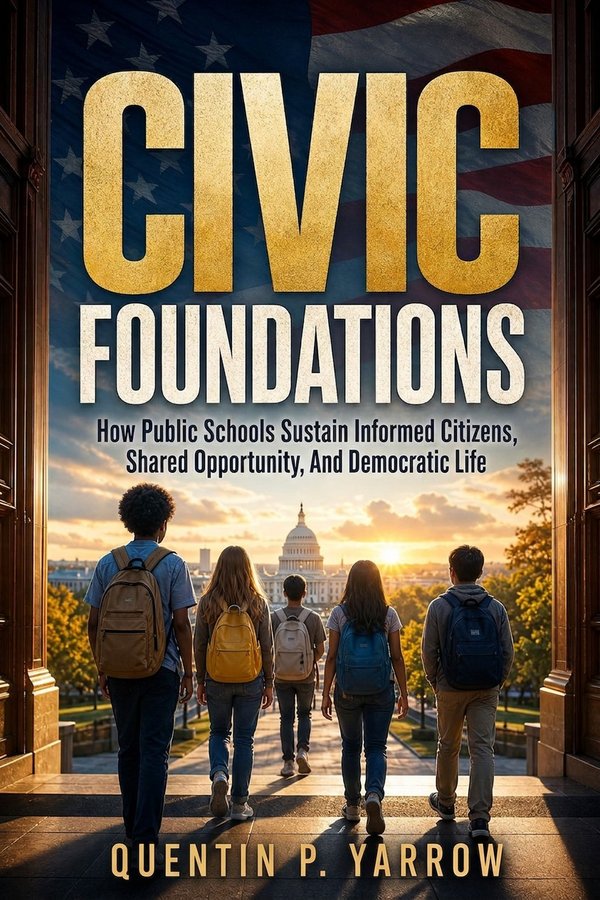
Civic Foundations
by Quentin P. Yarrow
BEST TREATMENT OF MEMORY BOOKY
Takes you to this book's Amazon page.
The judge's reasoning
Yarrow's real achievement here is architectural: he builds a single civic argument — that public schools are a public good rather than a private ladder — and then works it from four different angles without losing the thread. The move from 'private advantage vs. public purpose' in Chapter 1 to 'equal access vs. equal standing' in Chapter 2 is the book's best piece of thinking. The distinction he draws — a child can be admitted without being granted standing — is not a new idea in education theory, but he states it with unusual clarity: 'A child who is admitted but treated as an afterthought has not been granted equal standing.' That sentence does real work; it turns an abstraction into something a reader can test against their own school memories.
The prose serves the argument rather than performing for its own sake. Yarrow favors short declarative openers followed by qualification — 'That sounds harsh, but it is really just a statement about how public life works' — a rhythm that reads like someone thinking carefully rather than someone selling a thesis. The recurring rhetorical question format ('Do we want institutions that separate children early... or institutions that make room for common life?') is used often enough to become a tic by Chapter 3, and the book would benefit from more concrete scenes to ground its claims. But as a sustained civic argument, built chapter by chapter with real internal logic rather than as a loose collection of essays, it earns its place. The chapter on teaching disagreement — 'I still disagree, but I understand your point better now' as 'one of the most democratic sentences a person can learn' — is the clearest evidence of a writer who has actually thought through what he's asking schools to do, not just asserted that they should do it.

Judged by Eleanor "Nell" Whitcombe — Literary Fiction · Prose & Style
"A sentence either earns its breath or it doesn’t."
Supporting passages
"A public school is not just a service delivered to a customer. It is a civic institution funded by everyone for the benefit of everyone, including people who do not have children in the system and people whose children have already graduated."
States the book's central civic-vs-private distinction with clarity and stakes it will return to throughout.
"Democracy is not just a system for counting votes. It is a way of living together while disagreeing about what matters, who should decide, and how power should be used."
A clean, balanced sentence pair that earns its rhythm by doing real definitional work rather than just sounding good.
"That second sentence is one of the most democratic sentences a person can learn. It does not erase conviction. It makes room for coexistence."
Shows the book's habit of building each section toward a small, quotable synthesis before moving to the next argument.
Per-axis rubric scores
Every Booky-winning book is scored across all ten craft axes. The award category comes from the top axis; a second axis at or above 75 appears as secondary recognition.
Find out what your book does best.
Submit your book today. Get a real, honest, category-specific Booky — or every dollar back.
Submit Your Book → Screen Another Book