
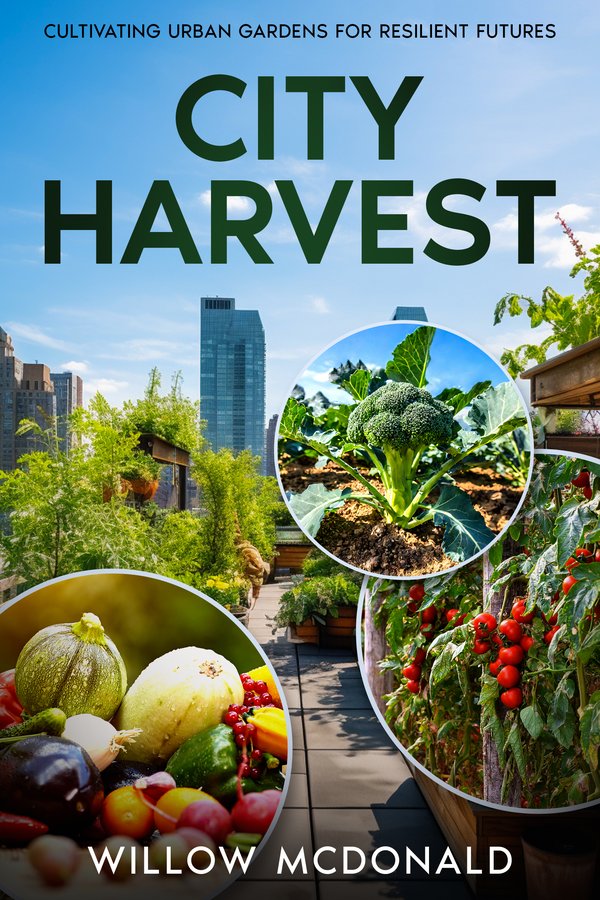
City Harvest
by Willow McDonald
MOST VIVID PLACE BOOKY
Takes you to this book's Amazon page.
The judge's reasoning
The prose in City Harvest runs on inspirational autopilot — 'tapestry,' 'quiet revolution,' and 'concrete jungle' recur so often across three chapters that they stop meaning anything, and the argument mostly restates itself in new adjectives rather than advancing. But when McDonald turns to her case studies in Chapter 5, the book finally stands on real ground. The catalogue of named, specific projects — the High Line's 1.45-mile reclaimed rail line, Gardens by the Bay's 101-hectare Supertree Grove that 'collect[s] rainwater' and vents nearby conservatories, Bosco Verticale's tree-clad towers hosting 'diverse bird species,' Oslo's Vulkan district, Toronto's Bentway built under a highway — gives the reader an actual, mappable sense of what global urban agriculture looks like on the ground. These aren't invented composites; they're identifiable places a reader could visit or research further, and that specificity is the strongest writing in the excerpt. The same instinct shows up earlier in the survey of hydroponics-versus-aeroponics water savings and the CSA origin story in the 1980s — moments where a concrete fact briefly cuts through the haze of uplift. This is a book built for readers who want a panoramic primer on the idea of urban agriculture and a stocked shelf of real-world reference points to chase down, more than a hands-on how-to manual — and on that survey level, the case-study chapter earns its place.

Judged by Eleanor "Nell" Whitcombe — Literary Fiction · Prose & Style
"A sentence either earns its breath or it doesn’t."
Supporting passages
"The 101-hectare garden features the Supertree Grove, towering vertical gardens that generate solar power, act as air venting ducts for nearby conservatories, and collect rainwater."
A concrete, verifiable detail that gives the reader an actual image of a real project rather than a generic green space.
"Hydroponics... using up to 95% less water compared to traditional agriculture—and the ability to grow crops year-round, regardless of the outside weather conditions."
A specific, citable figure that grounds the book's broader claims about urban farming's efficiency.
Per-axis rubric scores
Every Booky-winning book is scored across all ten craft axes. The award category comes from the top axis; a second axis at or above 75 appears as secondary recognition.
Find out what your book does best.
Submit your book today. Get a real, honest, category-specific Booky — or every dollar back.
Submit Your Book → Screen Another Book