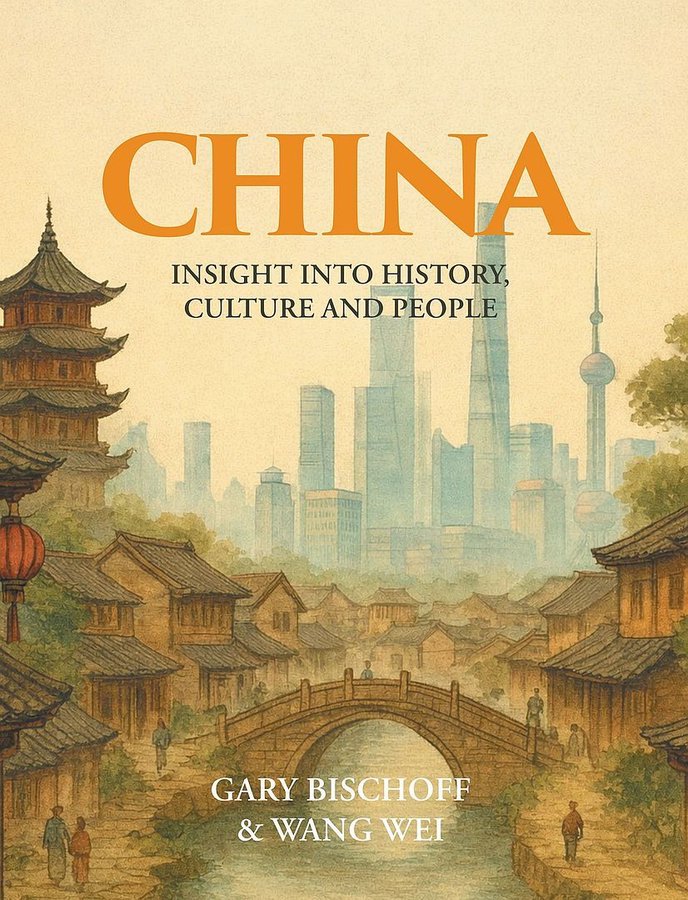
China: Insight into History, Culture and People
by Gary Bischoff and Wang Wei
BEST TREATMENT OF IDENTITY BOOKY
The judge's reasoning
This is not a book that asks to be judged on the music of its sentences, and I won't pretend otherwise. What Bischoff and Wang have built is a working reader's companion, and it earns its recognition on substance. They know what they are for. The introduction states the purpose plainly: to help Westerners read China without the reflexive hostility of the headlines, and to do so in chapters that "stand on their own." That promise is kept.
The strongest passages are the ones where the book connects a fact to a living habit. After describing the famine of the Great Leap Forward, the authors observe that the everyday greeting nǐ chī le ma? ("Have you eaten?") is "a throwback to times when people may not have eaten." That single turn does more to explain Chinese memory than a page of statistics could. The same instinct drives the one-child-policy section: the park scene of "a mother and father and four grandparents" around one child, and the unexpected consequence that girls in one-child families were educated with new seriousness.
The breadth is real and handled with discipline: dynasties, the Century of Humiliation, architecture (dougong brackets, horse head walls), tea, the Four Great Inventions, chengyu with their parables, hanzi taken apart by radical. The authors' own photographs of Qingdao, Suzhou and Nanjing, and Wang Wei's family calligraphy, give the book the texture of people who have actually walked these places.
As a reference, it is clear and fair, and it should find a ready audience among the curious general readers, students and learners it names.

Judged by Eleanor "Nell" Whitcombe — Literary Fiction · Prose & Style
"A sentence either earns its breath or it doesn’t."
Supporting passages
"In China, it is a common greeting when meeting someone to say “你吃了吗?” (nǐ chī le ma?), meaning “Have you eaten?” or “Did you eat yet?” This is a throwback to times when people may not have eaten."
A single everyday phrase is tied to the collective memory of famine, which is the book's best move: making history audible in daily speech.
"Traveling in China, we often see families in the parks with one child, a mother and father and four grandparents. This puts a lot of pressure on not only the children but on the rest of the family."
Firsthand observation turns an abstract policy into a lived social picture, exactly what an accessible cultural guide should do.
"Look at 相 xiāng, an adverb meaning each other or mutually, it is made up of tree and eye or an eye looking at a tree. Consider 心 xīn, meaning heart; keep in mind in ancient times the heart was believed to be the part of the body that had feelings and thought. Knowing this, can we deduce the meaning of 想 xiǎng?"
The authors invite the reader to reason through a character's construction, teaching a method for reading hanzi rather than just listing facts.
Per-axis rubric scores
Every Booky-winning book is scored across all ten craft axes. The award category comes from the top axis; a second axis at or above 75 appears as secondary recognition.
Find out what your book does best.
Submit your book today. Get a real, honest, category-specific Booky — or every dollar back.
Submit Your Book → Screen Another Book