
Breaking the Chain: Cutting Toxic Family Ties & Reclaiming Your Life
by Stacie Webb
MOST PRACTICAL SELF-HELP BOOKY
Retailer link provided by the author.
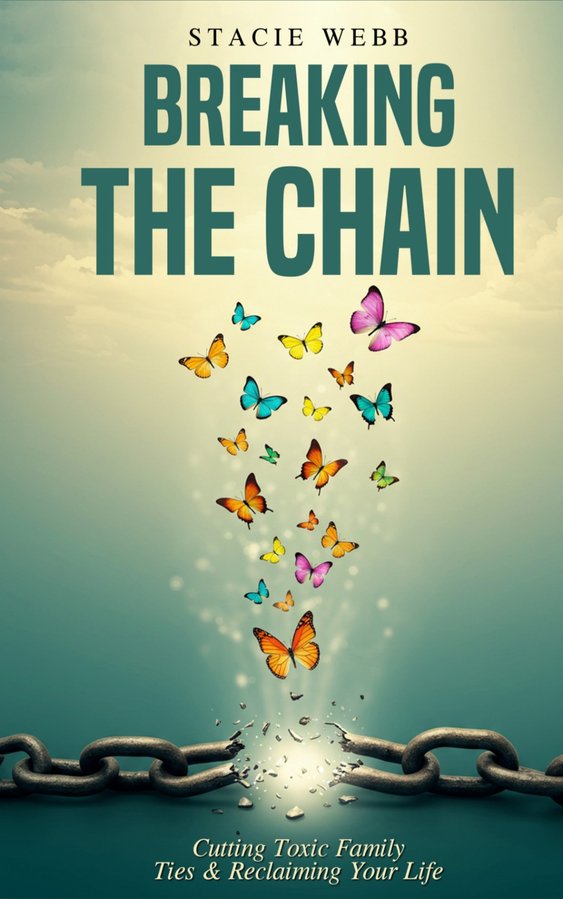
The judge's reasoning
Self-help lives or dies on one question: does the reader finish the chapter able to do something different on Tuesday? Breaking the Chain answers yes, again and again, and that is what earns it a Booky for Genre Execution.
The book is built as a working manual. Every chapter moves from naming a problem to handing over a tool, and the tools are specific. The JADE trap (don't Justify, Argue, Defend, or Explain) tells a reader exactly what to stop doing when a parent pushes back on a boundary. Chapter 4 maps the backlash in three phases, from boundary testing through guilt trips and "flying monkeys" to smear campaigns, so a reader who is mid-storm can say this is Phase 2, it's predictable, it passes. Chapter 12 doesn't just say "people won't understand"; it decodes what "But they're your family" and "Nobody's perfect" actually assume, then offers scripts sorted by how much each listener deserves to hear.
The argument is clear and fairly argued: love and obligation are not the same thing, forgiveness is separate from reconciliation, and contact is a spectrum. Webb's best structural choice is giving readers a full range of options (no contact, low contact, gray rock, intermediaries, written-only) and then asking them to decide for themselves rather than pushing estrangement. The chapter on dying abusers is the strongest. It takes on the deathbed-reconciliation myth and the pressure to show up, and it carries Webb's own hospice-informed observation that hasty reconnection brings its own regrets.
The dedication, "you were right to trust your feelings," sets the book's purpose: validation, then action.

Judged by Arthur Beaumont — Non-Fiction · Memoir · Business · Self-Help
"A good non-fiction book changes one specific thing about your week."
Supporting passages
"One of the biggest mistakes people make when setting boundaries is falling into the JADE trap. When family members push back against your boundaries (and they likely will), resist the urge to: Justify... Argue... Defend... Explain..."
A memorable, immediately usable technique that tells the reader precisely what to stop doing in the moment pressure arrives.
"Forgiveness and boundaries are separate decisions."
A clean, argued distinction that dismantles the most common trap in estrangement advice and carries the book's central thesis.
"I did not expect to grieve and be devastated by the death of someone I had never loved and had never had a relationship with."
A rare moment of the author's own voice cutting through the instructional register, naming the disenfranchised grief the chapter is about.
Per-axis rubric scores
Every Booky-winning book is scored across all ten craft axes. The award category comes from the top axis; a second axis at or above 75 appears as secondary recognition.
Find out what your book does best.
Submit your book today. Get a real, honest, category-specific Booky — or every dollar back.
Submit Your Book → Screen Another Book