
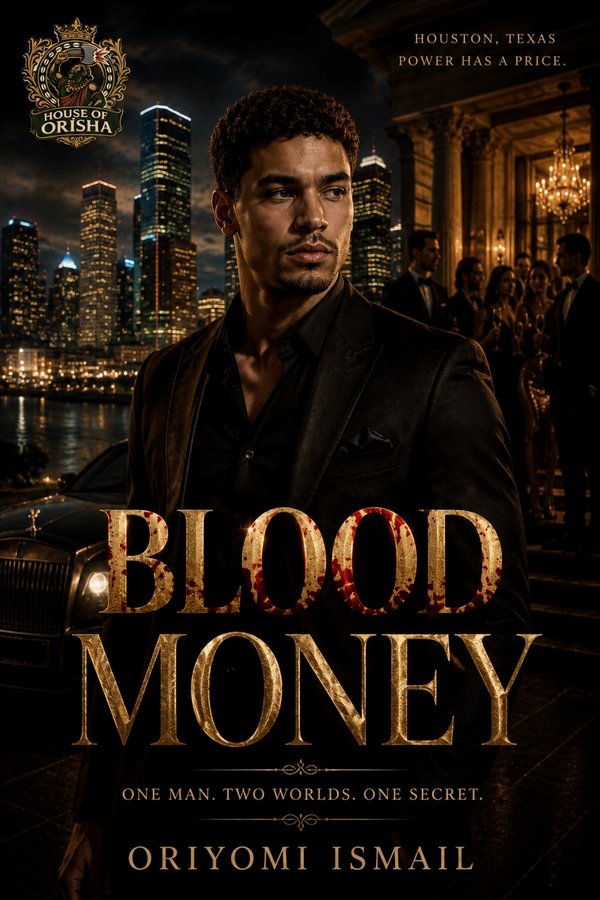
BLOOD MONEY
by Oriyomi Ismail
TENSEST THRILLER BOOKY
Takes you to this book's Amazon page.
The judge's reasoning
Ismail knows the machinery of a commercial thriller and builds it in plain sight, which is exactly the kind of transparency this genre rewards when it's done with confidence. The prologue does double duty — origin myth and ticking bomb — establishing Richard Carter's transformation into Richard Blackwood in a tight, controlled scene ("Blood money builds fast, but it doesn't stay clean") that pays off structurally the moment the son, Jason, walks toward that same tower in Chapter 1 without knowing what it means yet. That's dramatic irony done right, and it's the engine of the whole opening act.
The slap in Chapter 4 is the standout set piece: Ismail understands that the best humiliation scenes aren't about the injury, they're about the room's indifference afterward — "None of them looked. Not really." That line, plus Gloria's later "You didn't break because you're not the kind of man who breaks," earns its class-rage payoff without melodrama. And the Chapter 5 ambush — armored Bentley, ice-slick highway, physics doing what bullets couldn't — is a legitimately well-staged action sequence, mechanically sound and visually clear, ending on the gut-punch coincidence of Jason running toward the wreck of the very empire he doesn't yet know is his inheritance.
This is a book that understands promise and payoff at the sentence level and the chapter level both. The prose sometimes leans on repetition for emphasis (a stylistic tic, not a flaw exactly) but the pacing rarely stalls, and the chapter-title structure ("The Slap," "The Freeze") signals a writer thinking in scenes, which is the correct instinct for this genre.

Judged by Marcus Thorne — Thriller · Mystery · Suspense · Commercial Fiction
"Plot is promises kept."
Supporting passages
"None of them looked. Not really. None of them had any reason to. That was the knife. Not the slap. The people who would one day answer to him couldn't be bothered to watch him get hit."
The scene understands that indifference cuts deeper than violence, which is the mark of a writer who trusts subtext over spectacle.
"Later, he would learn that tower carried a name. Later, he would walk through its doors, sit in its rooms, and hold its future in his hands."
A direct promise to the reader planted in Chapter 1 that gives the whole opening act forward pull.
""You be careful out there, son. People are different in a big place. They don't know you. They don't know where you come from." "I know, Mama." "And you stay who you are. You hear me?""
The recurring phone calls with his mother ground the plot's grand inheritance mechanics in something small and real.
Per-axis rubric scores
Every Booky-winning book is scored across all ten craft axes. The award category comes from the top axis; a second axis at or above 75 appears as secondary recognition.
Find out what your book does best.
Submit your book today. Get a real, honest, category-specific Booky — or every dollar back.
Submit Your Book → Screen Another Book