
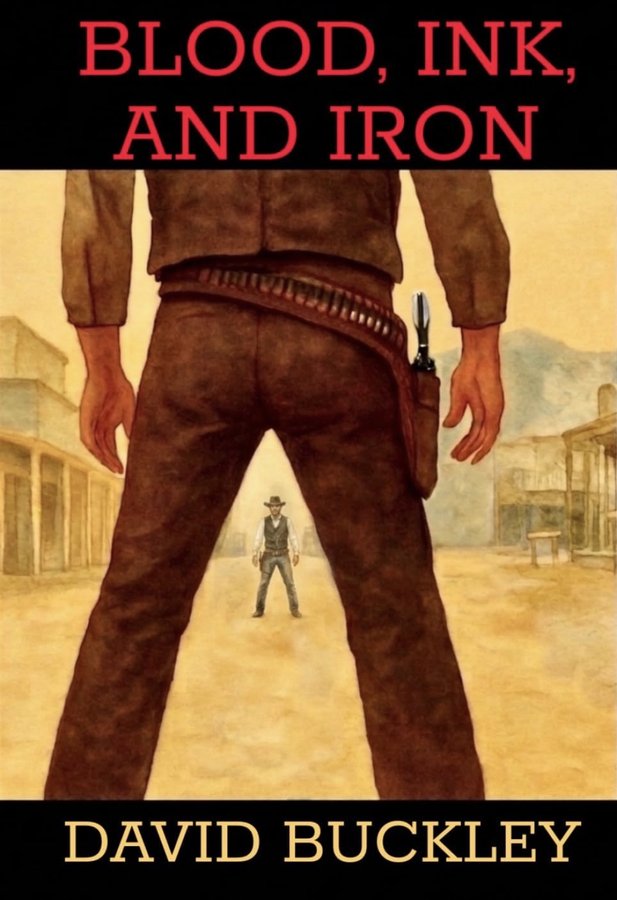
Blood, Ink, and Iron
by David Buckley
MOST MUSCULAR PROSE BOOKY
Takes you to this book's Amazon page.
The judge's reasoning
Blood, Ink, and Iron earns its breath at the sentence level, which is the first and hardest thing a Western literary novel has to do. David Buckley writes landscape the way it should be written — not as backdrop but as moral weather. The desert east of Redrock is "bare, fissured, and hung with a haze that turned all distances into rumor." The evening light becomes "bruised" and "flattens every feature" until "the world seem[s] older." These aren't decorative gestures; they're doing the thematic work of the book — a world that pre-exists its characters and will outlast them.
The craft is most assured in the parallel tracking sequences of Chapters 6–8, where Buckley braids present-tense pursuit with memory, and the physical act of reading sign — a stone turned dark-side-up, a hoof-print with a chipped wall, a single coarse hair in a weed root — becomes the grammar for how both men reconstruct the past. The Man's childhood memory of watching the Garett mother scoop up her bleeding daughter and rock her in the dirt is one of the quietly devastating beats of the excerpt: rendered without sentimentality, observed by a child who approaches love "with something like scientific interest." That restraint is exactly right.
Cole Bradshaw's voice in the saloon — all performance and lateral glances — is well-differentiated from The Man's studied silence, and the Civil War flashback in Chapters 9–10 earns its place by giving both men a shared prehistory without telegraphing it too heavily. The inquiry scene at the Colonel's tent, cut off mid-sentence, is structurally bold. Buckley trusts the reader.

Judged by Eleanor "Nell" Whitcombe — Literary Fiction · Prose & Style
"A sentence either earns its breath or it doesn’t."
Supporting passages
"Heat shimmered around horse and rider in an aura that warped the edges of man and beast until the line defining them was a matter of opinion."
This sentence does triple duty — atmosphere, character mystique, and the book's central thematic blur between identity and legend — with total economy.
"He found all of it, and more: a horseshoe nail, bent to an L; a slip of greasy paper with a corner torn away; a single hair, black and coarse, caught in the root of a weed."
The forensic specificity here builds a world governed by material consequence — one where survival is a reading practice — and it feels earned rather than performed.
"The Man, as a child, watched it with something like scientific interest. He wondered what it might be like to have someone reach for you when you hurt, to say your name and mean it."
This is the emotional core of The Man's characterization, delivered without self-pity and all the more affecting for the clinical distance the prose maintains.
Per-axis rubric scores
Every Booky-winning book is scored across all ten craft axes. The award category comes from the top axis; a second axis at or above 75 appears as secondary recognition.
Find out what your book does best.
Submit your book today. Get a real, honest, category-specific Booky — or every dollar back.
Submit Your Book → Screen Another Book