
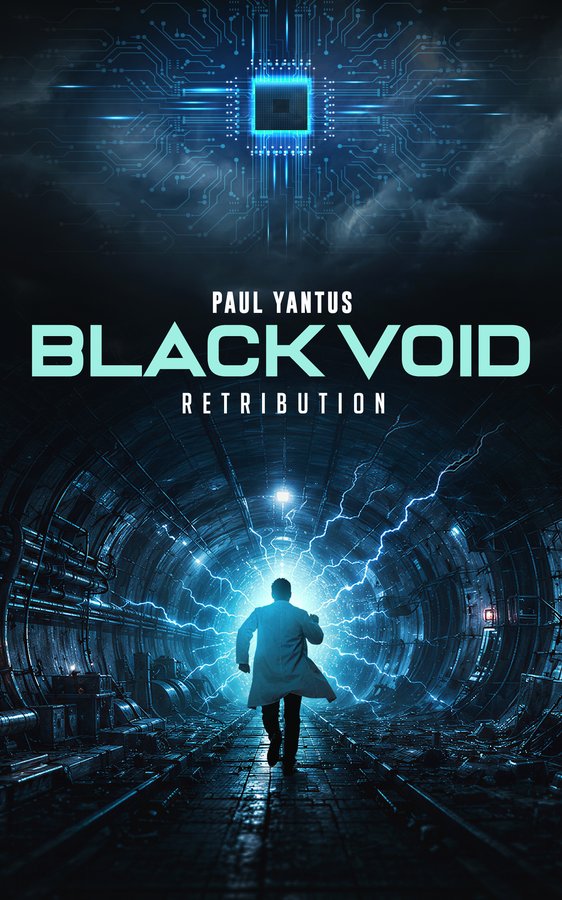
Black Void Retribution
by Paul Yantus
MOST UNSETTLING ATMOSPHERE BOOKY
The judge's reasoning
Yantus's hook is genuinely fresh: a foundation that monetizes black-hole waste disposal, run by the physicist who accidentally created the technology that killed her team and her fiancé. That's a strange, commercially sturdy premise — Michael Crichton's science-runs-amok DNA crossed with a corporate-thriller revenge plot — and the book commits to the mechanics of it. The whiteboard scene where Andie explains merging black holes to Carlos, the Faraday-cage disposal sequence with its sixty-ton uranium container, the 'gravitational shift' visions the characters share when the weapon fires — these aren't hand-waved. The book wants you to believe its own physics, and mostly earns that by grounding jargon in scenes with stakes (Petra's outburst 'You idiot! You don't know the difference between hazardous and nuclear waste?' lands because we understand exactly what's at risk).
The originality is in the premise architecture itself: black holes as garbage disposal, a Nobel-bait CEO who insists on being called Andie, a vengeful ex-executive with an AI assistant named Wendy nudging him toward retribution. Jeremy's elimination-list scene — narrowing seventeen names down to three via an AI query — is a clean, efficient way to introduce a antagonist's methodology without a monologue.
Where the book strains is dialogue (characters often speak in exposition-delivery mode rather than voice) and emotional resonance (Andie's grief for Jack is told more than felt, and the birthday-party finale swings tonally toward comedy just as it should be landing loss). But the sandbox this book built — corporate intrigue plus applied astrophysics plus black-ops revenge — is vivid enough, and specific enough in its rules, to be the thing readers remember.

Judged by Marcus Thorne — Thriller · Mystery · Suspense · Commercial Fiction
"Plot is promises kept."
Supporting passages
"The conductive enclosure blocked external electromagnetic fields from escaping and protected them from the radiation emitted when a black hole collapsed."
Establishes a lived-in, rules-based technology rather than vague sci-fi hand-waving.
"Andie's idea of using black holes to eliminate waste had proven to be a stroke of genius."
The core premise — black holes as a waste-management business — is a distinctive, marketable engine for the plot.
""Wendy, eliminate anyone who didn't interact with the Fairmont Foundation's black ops team." On the wall before him was a list of three names."
Economical scene that sets up the antagonist's team and motive without exposition dumps.
Per-axis rubric scores
Every Booky-winning book is scored across all ten craft axes. The award category comes from the top axis; a second axis at or above 75 appears as secondary recognition.
Find out what your book does best.
Submit your book today. Get a real, honest, category-specific Booky — or every dollar back.
Submit Your Book → Screen Another Book