
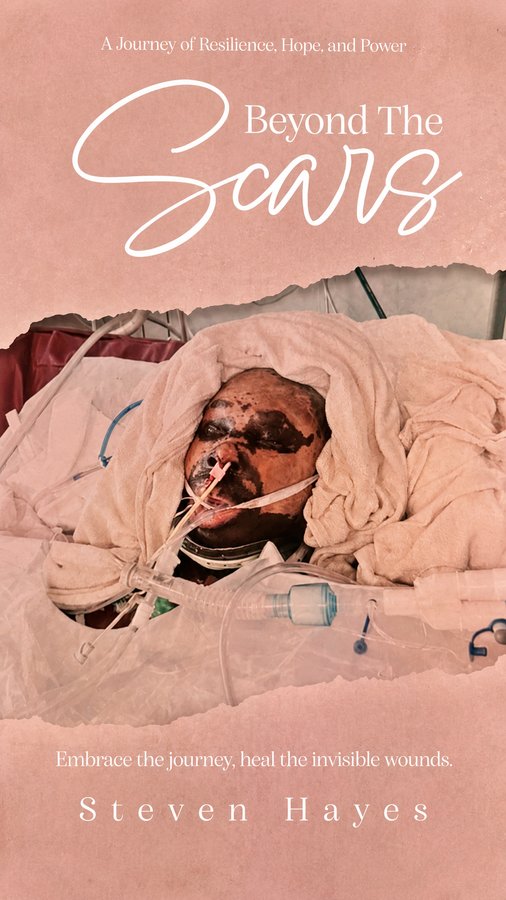
Beyond The Scars
by Steven Hayes
BEST TREATMENT OF GRIEF BOOKY
Takes you to this book's Amazon page.
The judge's reasoning
Hayes has found a genuinely underserved niche: recovery literature for people whose trauma is visible on the body — burn survivors, accident and surgery patients, anyone whose face or skin no longer matches their sense of self. That specificity is the book's real strength. Where most trauma self-help gestures vaguely at 'healing,' this manuscript names concrete, recognizable moments — 'the cashier stared at my scars while I paid for groceries,' changing clothes in the dark, covering a mirror with a towel and revealing it 'one section at a time.' The 'Emotional Archaeology' framework, while borrowed conceptually from somatic and IFS-adjacent trauma work, is renamed and organized with real discipline: body scan, three questions to the emotion, titration, container visualization, pendulation. Each chapter follows the same reliable architecture — diagnosis, reframe, then a numbered set of exercises with explicit dosages ('10-15 minute sessions,' '30 seconds,' '5 minutes each evening') — which is exactly what this genre's reader wants: something to do on a bad day, not just something to feel less alone about. The mirror-work section, moving from face-down mirror to peripheral vision to body-part progression, is the standout passage — it's staged like exposure therapy, sequenced with actual clinical logic rather than vague affirmation. The prose leans repetitive and the voice rarely surprises, but the book delivers what its cover promises: a structured, humane roadmap for a specific and rarely addressed grief.

Judged by Arthur Beaumont — Non-Fiction · Memoir · Business · Self-Help
"A good non-fiction book changes one specific thing about your week."
Supporting passages
"Use the body part progression method by covering a mirror with a towel and revealing only small sections at a time, starting with areas of your body that feel most neutral or acceptable to you."
A concrete, staged exercise that treats mirror avoidance with real behavioral specificity rather than generic affirmation.
"Use this format: "At [time] I felt [specific emotion] when [specific situation] happened." For example: "At 10am I felt shame when the cashier stared at my scars while I paid for groceries.""
Grounds an abstract concept in a scriptable, immediately usable template — the hallmark of functional self-help craft.
"The person you were before your trauma didn't just change; they died in the moment your life was forever altered, and nobody prepared you for the profound grief that comes with losing your former self."
Names an unspoken grief specific to disfiguring trauma with a directness that will land for its intended reader.
Per-axis rubric scores
Every Booky-winning book is scored across all ten craft axes. The award category comes from the top axis; a second axis at or above 75 appears as secondary recognition.
Find out what your book does best.
Submit your book today. Get a real, honest, category-specific Booky — or every dollar back.
Submit Your Book → Screen Another Book