
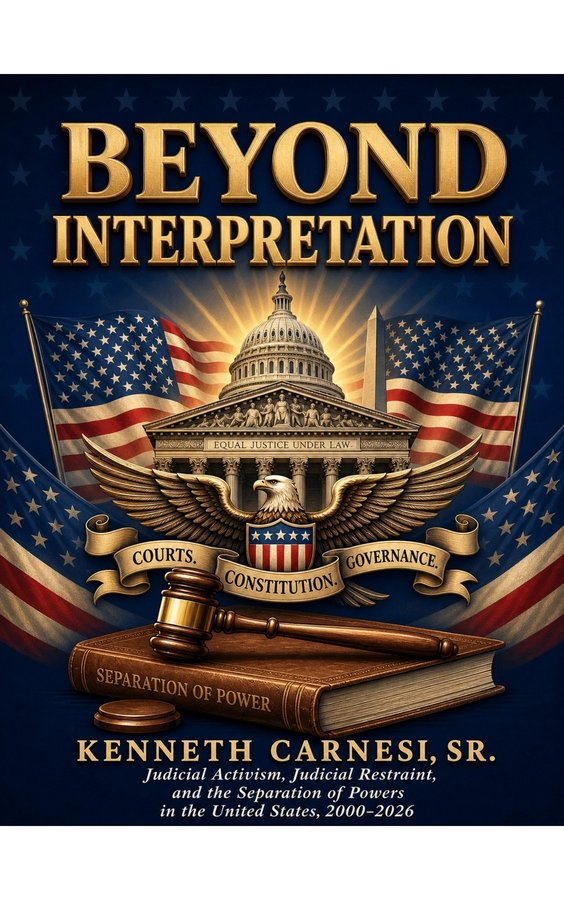
Beyond Interpretation
by Kenneth Carnesi, Sr.
BEST MORAL COMPLEXITY BOOKY
The judge's reasoning
Carnesi's real achievement here is disciplinary honesty about a term that usually gets deployed as a slur. The book opens by refusing the easy move — declaring one definition of "judicial activism" correct and scoring cases against it — and instead builds a six-definition taxonomy (invalidating legislation, overturning precedent, departing from original meaning, reaching beyond the facts, substituting policy for analysis, and structural counter-majoritarianism) that it then interrogates rather than deploys. The observation that "the label travels with the verdict, not with any consistent analytical standard" is the book's thesis in miniature, and it's demonstrated rather than asserted — the parallel treatment of Lochner-era, Warren Court, and Roberts Court activism charges is genuinely evenhanded, tracing how the same vocabulary serves opposite political ends across eight decades.
The argument structure is the book's strongest craft element. Chapter 1 sets the constitutional baseline (Article III mechanics, Marbury, inter-branch checks), Chapter 2 builds the analytical lens, and each case chapter promises the same four-part rubric: what the Court held, the vote breakdown, contemporaneous reception across the spectrum, and doctrinal legacy. That's a serious methodological commitment for a book covering 26 years and two dozen landmark cases, and the Bush v. Gore chapter opening delivers on it — precise on the safe-harbor deadline mechanics, the per curiam's self-limiting language, and the odd 7-2/5-4 split structure that many popular accounts flatten.
The prose is dry but purposeful, exactly suited to its stated readership of "attorneys and journalists who already know the law." It won't move a general reader emotionally, and it doesn't try to. What it delivers is a usable framework — readers really will walk away able to ask sharper questions about the next contested ruling.

Judged by Arthur Beaumont — Non-Fiction · Memoir · Business · Self-Help
"A good non-fiction book changes one specific thing about your week."
Supporting passages
"That pattern tells you something. It doesn't tell you which rulings were actually activist. It tells you that the label travels with the verdict, not with any consistent analytical standard."
This is the book's central analytical claim, stated with precision rather than partisan hedging.
"Each chapter follows the same structure: factual and procedural background, the Court's stated legal rationale, the vote breakdown and authoring justices, contemporaneous reactions across the ideological spectrum, and the decision's doctrinal legacy."
A disciplined, repeatable framework that gives the 26-year survey coherence across two dozen disparate cases.
"The recount could not be completed in time while also implementing the uniform standards that equal protection demanded. Therefore, the majority held, no further recount was permissible."
Demonstrates command of the procedural terrain — the 'lived world' of appellate mechanics rendered with genuine clarity.
Per-axis rubric scores
Every Booky-winning book is scored across all ten craft axes. The award category comes from the top axis; a second axis at or above 75 appears as secondary recognition.
Find out what your book does best.
Submit your book today. Get a real, honest, category-specific Booky — or every dollar back.
Submit Your Book → Screen Another Book