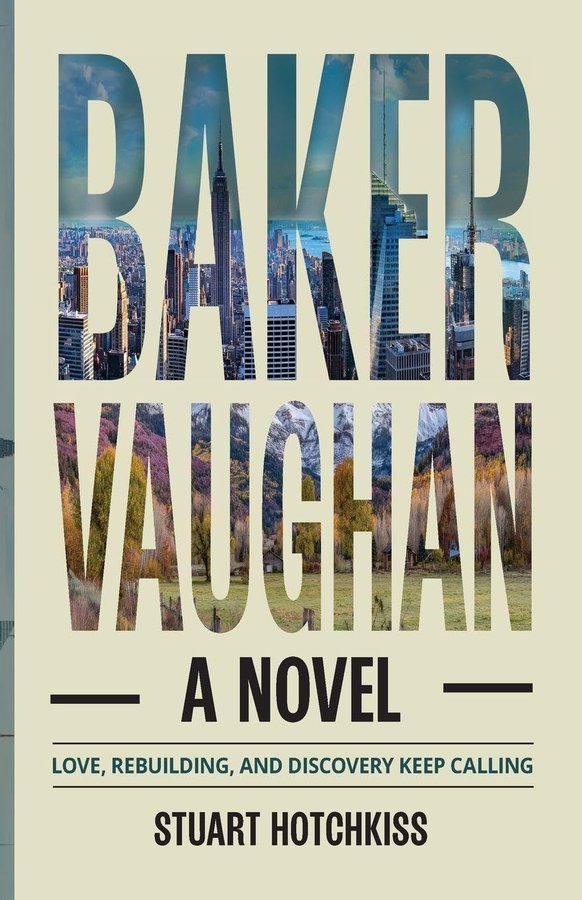
Baker Vaughan: A Novel
by Stuart Hotchkiss
BEST CHARACTER GROWTH BOOKY
Takes you to this book's Amazon page.
The judge's reasoning
Hotchkiss's real gift here is psychological architecture, not sentence-level restraint. Baker Vaughan arrives fully wired with a pattern the book keeps tightening around him: the golden boy at McGraw who 'learned early how to maintain appearances,' the man who tells Russ a stranger's confession he's already told a bishop and will tell again, the husband who 'didn't move in with [Michelle] so much as incorporate her.' That line about the marriage — 'Both of them were excellent actors. Both of them knew their lines' — is the book's sharpest observation, and it earns the later collapse instead of merely announcing it.
The generational thread is handled with real specificity rather than pop psychology: his mother's 'allergy to alcohol,' the cellarette he picks the lock on at thirteen, the moment years later when Baker recognizes his own drinking as 'inevitable rather than chosen.' That's a writer who understands how addiction gets inherited as behavior, not just diagnosis.
The bicycle scene on Rivermont Avenue — overwritten in places ('warm honey, sweet and thick') — nonetheless does the hard work of making a religious calling feel like a bodily event rather than a plot device, and it pays off cleanly against Uncle Oscar's brutal 'People get spiritual experiences from bad pizza.' Melissa Ashcroft's aside — 'People like us, we're very good at making people small' — is a small character doing real thematic labor in one scene. The prose leans melodramatic and tells more than it should, but the man underneath it is drawn with genuine, patient attention.

Judged by Eleanor "Nell" Whitcombe — Literary Fiction · Prose & Style
"A sentence either earns its breath or it doesn’t."
Supporting passages
"For twenty years, they performed their life together. The right restaurants, the right vacations, the right investment decisions. Both of them were excellent actors. Both of them knew their lines."
A precise diagnosis of a marriage built on complementary silences, not sentiment.
"Everything he thought was solid was as carefully constructed and hollow as the advertising campaigns he created."
The novel's central thematic claim, landed cleanly without underlining.
""Then you'd better answer," she whispered into his hair. "Because those kinds of calls don't come twice.""
A quiet maternal moment that earns its warmth without overplaying it.
Per-axis rubric scores
Every Booky-winning book is scored across all ten craft axes. The award category comes from the top axis; a second axis at or above 75 appears as secondary recognition.
Find out what your book does best.
Submit your book today. Get a real, honest, category-specific Booky — or every dollar back.
Submit Your Book → Screen Another Book