
Baker Battery Goes to War
by Patrick W. Naughton, Jr.
MOST UNSETTLING ATMOSPHERE BOOKY
The judge's reasoning
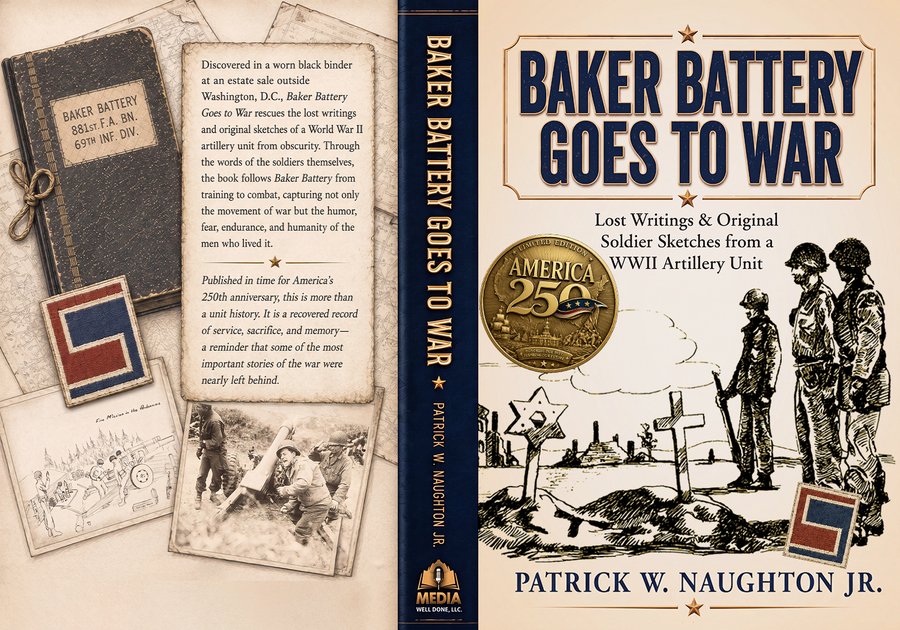
Naughton's book earns its place on a strength that's easy to name: he has taken a physical object — a single surviving mimeographed unit history, found in a Northern Virginia estate-sale binder marked Vertrauensrat — and rebuilt the lived texture of an artillery battery's war around it. That's not a metaphor. It's a real archival find, and the book treats it that way, tracing the binder's authorship down to individual men (Custis, Dowling, Glatfelter, Eisenberg) with the kind of granular, sometimes melancholy postwar biography — bowling leagues in Deer River, Alzheimer's, a Baptist mission in Florida — that makes WWII-era unit history feel like it's still breathing.
The world-building comes from layering: strategic context (Bolte's punishing training doctrine, the Fire Direction Center's mathematics, the mechanics of Time on Target missions) sits directly against the soldiers' own voice, as in the Camp Shelby diary entry's deadpan inventory of Thanksgiving dinner on a troop train, or the wickedly precise detail that the USS Lejeune was once the German raider Windhuk, its old name still stamped faintly inside the bell that rings reveille at Camp Lejeune today. That's the kind of fact a good military historian earns through legwork, not invention.
The originality is structural, not stylistic: rather than paraphrasing the primary source, Naughton frames it, footnotes it, and steps back — letting Custis and Ritter's prose carry the emotional weight while he supplies the connective strategic tissue. The author's own cancer-treatment framing in the note is restrained and doesn't overreach into the narrative proper, which is the right call. This is a book for descendants, division-history readers, and WWII completists, and it delivers exactly what that reader wants: rescued voices, properly contextualized.

Judged by Arthur Beaumont — Non-Fiction · Memoir · Business · Self-Help
"A good non-fiction book changes one specific thing about your week."
Supporting passages
"USS LEJEUNE 1944 is conspicuously and proudly inscribed on its exterior. Less well known is the single faded inscription hidden inside the bell: Windhuk."
A small physical detail that carries the ship's entire hidden history and exemplifies the book's instinct for the telling artifact.
"“This is gold,” I thought as I thumbed through it and tucked it under my arm like a football."
The estate-sale discovery frame gives the book a distinct, personal hook rare in unit histories.
"Doctrine and firepower explain how Baker Battery fought. They do not explain what the war felt like inside the unit."
States the book's organizing argument plainly: strategic context in service of recovering lived experience.
Per-axis rubric scores
Every Booky-winning book is scored across all ten craft axes. The award category comes from the top axis; a second axis at or above 75 appears as secondary recognition.
Find out what your book does best.
Submit your book today. Get a real, honest, category-specific Booky — or every dollar back.
Submit Your Book → Screen Another Book