
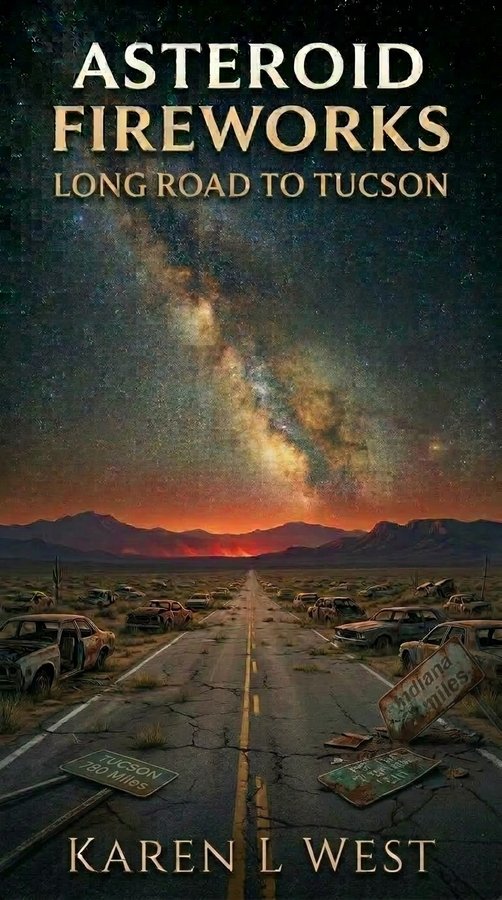
Asteroid Fireworks: Long Road to Tucson
by Karen L West
MOST INVENTIVE SCI-FI BOOKY
The judge's reasoning
West understands what the prepper/survivalist wing of post-apocalyptic fiction actually promises its readers, and she delivers it without cutting corners. This isn't a book that hand-waves the logistics of surviving the end of the world — it shows the work. The Fort Drum scavenging sequence ("Solar panels. Solar generators. Battery tools. Camping stoves. Dry food. Canned food. Water filters.") reads like an inventory because that's the point: readers of this subgenre want to feel the weight of preparation, not just the drama of crisis. The Wild River RV chapter goes further, walking through specific floorplans, bunk configurations, diesel-versus-gas tradeoffs, and solar retrofits with the patience of someone who has actually thought through how seven adults and a growing pack of orphaned children would need to live on the road. That granularity is the book's real spine, and it's a legitimate craft choice for the genre it's writing in.
The world-building benefits from the same instinct: Fort Drum's silence — "It was supposed to hum, rumble, shout, train, move. Now the wind moved loose paper across the pavement, and nothing answered it" — is an effective, economical way to convey scale of loss through absence rather than spectacle. And the quiet horror of Karl and Clara Ann reduced to ash in Clara Ann's wedding dress and Karl's dress uniform is the strongest single image in this opening stretch — restrained, specific, and earned by the couple's earlier warmth. When the book trusts a detail like that to do its own work, it's genuinely moving.

Judged by Eleanor "Nell" Whitcombe — Literary Fiction · Prose & Style
"A sentence either earns its breath or it doesn’t."
Supporting passages
"We raided Lowes, Tractor Supply, Grainger, Walmart, Costco, and a sporting goods store. Solar panels. Solar generators. Battery tools. Camping stoves. Dry food. Canned food. Water filters."
The inventory-as-narrative approach is a deliberate genre pleasure, giving survivalist-minded readers the tactile detail they come for.
"Fort Drum was not supposed to be silent. It was supposed to hum, rumble, shout, train, move. Now the wind moved loose paper across the pavement, and nothing answered it."
A concrete sensory contrast that conveys the scale of the die-off more effectively than exposition could.
"Clara Ann wore her wedding dress. Karl wore his dress uniform."
A restrained, devastating detail that lets the reader supply the grief rather than being told to feel it.
Per-axis rubric scores
Every Booky-winning book is scored across all ten craft axes. The award category comes from the top axis; a second axis at or above 75 appears as secondary recognition.
Find out what your book does best.
Submit your book today. Get a real, honest, category-specific Booky — or every dollar back.
Submit Your Book → Screen Another Book