
AI Made Simple: A Plain-English Guide to Understanding AI, GenAI, Machine Learning, and LLMs
by John Binks
DEEPEST THEME BOOKY
Retailer link provided by the author.
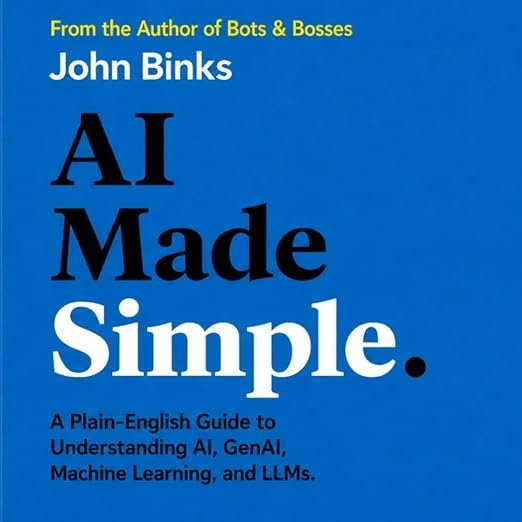
The judge's reasoning
A good non-fiction book changes one specific thing about your week, and AI Made Simple does that more reliably than most of the crowded AI-explainer shelf. John Binks has an actual argument: AI literacy means knowing what kind of system you're dealing with, what information it has, and how much verification the consequence demands. He builds the book around that thesis rather than around product tours that will date by next quarter.
The substance holds up. The distinction between training and context ("Training changes the model. Inference uses it") is the most commonly muddled idea in the field, and Chapter 4 handles it cleanly. The "model is the engine, the application is the entire vehicle" framing in Chapter 5 explains why two assistants can answer the same question differently, because of system instructions, tools, and retrieval, not just the model. Chapter 6's Verification Ladder (low, moderate and high consequence) is the book's most portable idea: match checking effort to what a wrong answer would cost. The hotel-booking example of assistant versus agent, and the observation that "generating advice and taking action are not the same level of responsibility," give readers something to apply by Monday.
The book is also calibrated. It declines to put a countdown clock on AGI, notes the definition is contested, and offers four buckets (exists now, emerging, experimental, speculative) for judging future claims. The Chapter 8 section on the junior-work problem, where automating entry-level tasks can erode the apprenticeship that builds judgment, is a genuinely original observation, delivered without alarmism.
The repeated Made Simple, Remember This and Try This callouts and the end-of-chapter summaries make it a reference a manager can return to. It is a well-organized, honest primer that earns its title.

Judged by Arthur Beaumont — Non-Fiction · Memoir · Business · Self-Help
"A good non-fiction book changes one specific thing about your week."
Supporting passages
"The model may be the engine. The application is the entire vehicle."
A compact analogy that separates the LLM from the assistant product and explains why outputs differ between apparently similar tools.
"The question is not whether AI needs verification. The question is how much verification the task deserves."
States the book's most practical principle, matching verification effort to consequence, in a form a reader can apply immediately.
"Organizations that automate too much of that work may gain short-term efficiency while weakening the path by which future experts learn."
An original, workplace-relevant insight about entry-level work and the erosion of expertise, raised with a constructive remedy rather than hype.
Per-axis rubric scores
Every Booky-winning book is scored across all ten craft axes. The award category comes from the top axis; a second axis at or above 75 appears as secondary recognition.
Find out what your book does best.
Submit your book today. Get a real, honest, category-specific Booky — or every dollar back.
Submit Your Book → Screen Another Book