
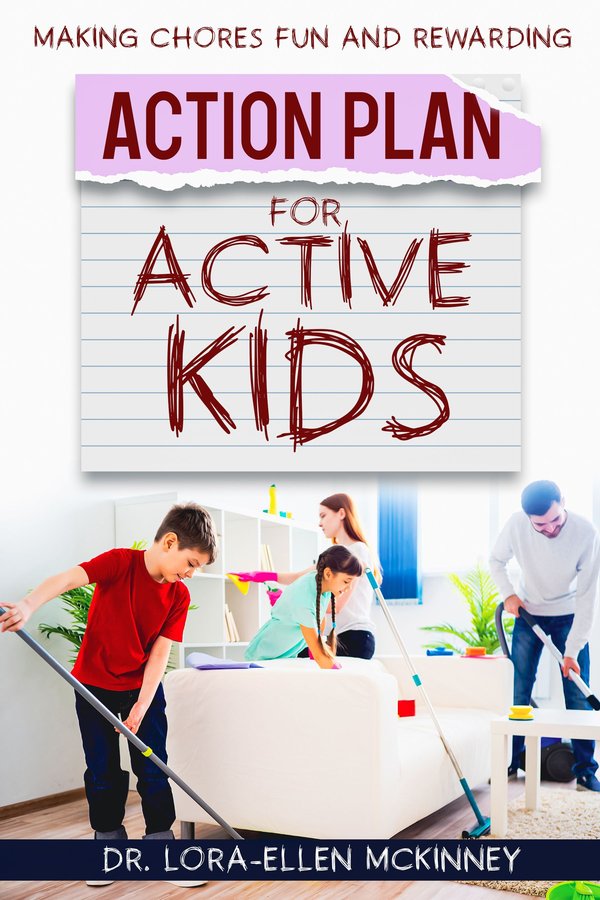
Action Plan for Active Kids
by Dr. Lora-Ellen McKinney
DEEPEST THEME BOOKY
Takes you to this book's Amazon page.
The judge's reasoning
This is a parenting guide, not a novel, and it should be judged on what it promises its reader: a usable framework for assigning chores across childhood. On that measure, McKinney delivers a genuinely well-organized, age-banded system — Chapter 5's breakdown into 3-5, 6-9, 10-13, and 14-18 is the book's strongest stretch, moving from 'picking up toys' to 'understanding basic financial responsibilities like budgeting' with a clear developmental logic a tired parent can actually apply on a Tuesday night. The Galinsky six-stages digression in Chapter 2, while academic in tone, gives the tailoring advice real scaffolding rather than leaving it as vague encouragement.
The book's substance holds up because it doesn't stop at 'assign chores' — it works through the harder, more contentious questions parents actually argue about: allowance versus unpaid contribution ('assigning monetary value to certain tasks, while ensuring others are recognized as family contributions without a reward'), rewards versus natural consequences (the lawn-mowing/car-privilege example is concrete and well-chosen), and the risk that over-rewarding erodes intrinsic motivation. That's a real parenting tension, handled with some nuance rather than platitude.
Where the book is weakest — and this drags several axes down hard — is prose economy. The introduction and early chapters restate the same thesis (chores build responsibility, teamwork, family unity) in near-identical sentences four or five times before any concrete example arrives, and the citation-heavy academic register ('Damon, 2008'; 'Grusec, 2020') often substitutes for illustration. Readers came for the age-by-age action plan, and once the book gets there, it earns its keep.

Judged by Eleanor "Nell" Whitcombe — Literary Fiction · Prose & Style
"A sentence either earns its breath or it doesn’t."
Supporting passages
"If a teen neglects their responsibility to mow the lawn, a natural consequence might be losing the privilege of using the family car for a day."
A concrete, well-chosen example that grounds the abstract rewards-vs-consequences argument in a scenario parents will recognize.
"For adolescents, ages 10-18, chores can be more demanding and diverse, mirroring their advancing capabilities and the approach of adulthood... involving teens in more complex family chores prepares them for life beyond the home"
The age-banded structure is the book's organizing strength and delivers exactly the practical scaffolding its genre promises.
Per-axis rubric scores
Every Booky-winning book is scored across all ten craft axes. The award category comes from the top axis; a second axis at or above 75 appears as secondary recognition.
Find out what your book does best.
Submit your book today. Get a real, honest, category-specific Booky — or every dollar back.
Submit Your Book → Screen Another Book