
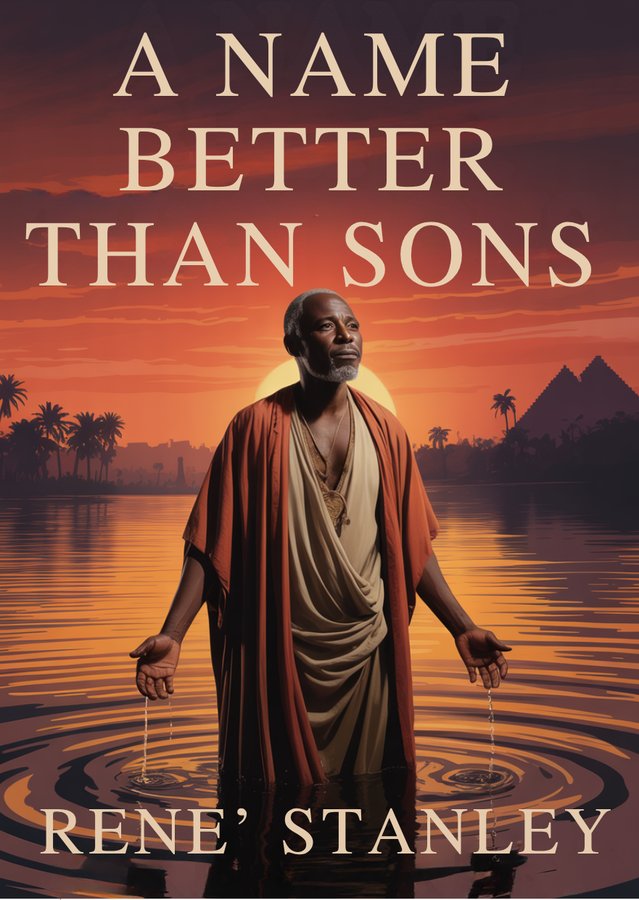
A Name Better Than Sons
by Rene’ Stanley
BEST TREATMENT OF CLASS BOOKY
Takes you to this book's Amazon page.
The judge's reasoning
The engine of this book is a genuine theological wound, and Stanley never lets it go slack. Simeon carries Deuteronomy 23:1 — 'Lo yavo' / He shall not enter' — against Isaiah 56's promise of 'a name better than sons and daughters,' and the novel treats that contradiction not as background but as the actual plot. The unnamed merchant's needling question, 'Which word do you prefer? Endless sons and daughters? Or a monument in a house you can never enter?', is the kind of line that earns its cruelty because it's specific rather than generic villainy — and it recurs in Simeon's mind exactly the way an old wound recurs, unbidden, at inconvenient hours.
What elevates this above devotional fiction is the structural audacity of making Simeon's treasury-auditor mind the instrument through which he investigates both fraud and murder — and, implicitly, Scripture itself. 'A treasury auditor does not walk immediately to the suspected entry point. He looks at the room as a system first' is not just procedural color; it's characterization doing double duty, showing us a man whose entire adult method is looking twice at things that don't add up, applied now to his own exclusion. The eunuch of Acts 8:27–39 given 'a name, a history, and a future the text invites but does not supply' is a legitimately inventive premise, executed with real research discipline (Meroë's court, the treasury politics, the Jerusalem assembly's factional strain) rather than costume-drama gesture. The book knows exactly what question it's asking and refuses to answer it cheaply.

Judged by Eleanor "Nell" Whitcombe — Literary Fiction · Prose & Style
"A sentence either earns its breath or it doesn’t."
Supporting passages
"Lo yavo’ He shall not enter. Three words in Hebrew like a gate with no handle on the inside."
The novel's central wound compressed into a single image that returns, unforced, throughout the book.
"A treasury auditor does not walk immediately to the suspected entry point. He looks at the room as a system first — everything in relation to everything else, the general before the particular — and only then moves toward what does not fit."
The premise's real invention: a ledger-examiner's method turned on a murder scene and, by extension, on Scripture itself.
"Numbers did not look away from his scars. They did not whisper when he entered a room. They only added, or did not."
A spare, earned line that tells us exactly why this man trusts figures over faces.
Per-axis rubric scores
Every Booky-winning book is scored across all ten craft axes. The award category comes from the top axis; a second axis at or above 75 appears as secondary recognition.
Find out what your book does best.
Submit your book today. Get a real, honest, category-specific Booky — or every dollar back.
Submit Your Book → Screen Another Book