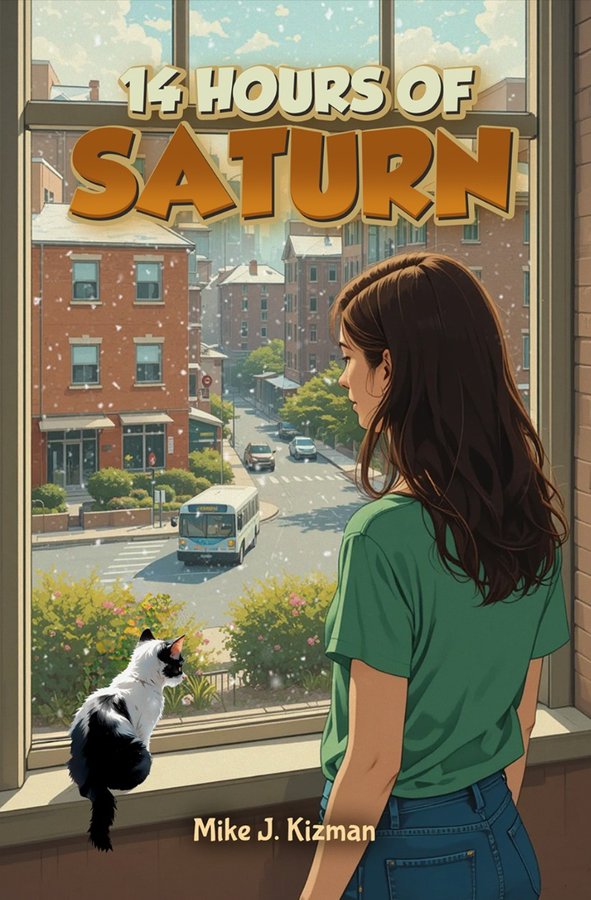
14 Hours of Saturn
by Mike J. Kizman
TRUEST COMING-OF-AGE VOICE BOOKY
Takes you to this book's Amazon page.
The judge's reasoning
What 14 Hours of Saturn gets exactly right is its narrator.
Saturn O Syres — and yes, the author makes you earn that full name — is one of the more genuinely lived-in first-person voices I've encountered in self-published literary fiction. Kizman's achievement here isn't flashy; it's accumulative. By the time Saturn explains that she still keeps a stirrer in her black coffee not for flavor but as a petty, private, ongoing victory over her sister, you understand this woman entirely: her humor, her stubbornness, her hunger for small dignities, the way she has metabolized years of low-grade unfairness into something almost cheerful. That's characterization doing serious work.
The Venus dynamic is the engine of these opening chapters, and it earns its space. The craft-stick sequence — Saturn building increasingly intricate structures in secret, hiding them behind their mother's wedding dress in the basement — is the book's best scene so far. It carries real emotional weight: the mother's quiet recognition ("May I keep this one?"), Venus's deliberate "accidental" drop, Saturn's muted pride. Kizman doesn't underline any of it. He lets it sit, and that restraint is where the book trusts its reader most.
Saturn's voice is chatty and digressive in a way that suits the premise — one rainy Saturday, nowhere to be, talking to you — and there are moments where the conversational register lands with genuine warmth and wit. The coffee-cup arithmetic, the breakfast yolk grief, the mashed potato gravy well: these domestic particulars build a person rather than merely describe one. That's what this book does, and it does it well.

Judged by Eleanor "Nell" Whitcombe — Literary Fiction · Prose & Style
"A sentence either earns its breath or it doesn’t."
Supporting passages
"I have since weaned myself from adding sugar and now take it black at home, but I still put a stirrer in it. I'm not sure if it's purely out of habit or a reminder of one of my few victories over Venus, but for whatever reason, that stirrer is always present. Yeah, I can be petty at times, too. Venus doesn't hold a monopoly on that."
This moment crystallizes Saturn's self-awareness — she sees her own pettiness clearly and claims it without apology, which is exactly the kind of complexity that makes a narrator feel like a real person.
"Mom looked at each one, then turned to me. "Did you make these yourself?" she asked as she looked right at me. "Yes," I answered, barely audible. Mom looked again at the crafts, then over to Venus, back to me, then back to Venus, who was standing indignantly next to the many creations. "These are very good, Saturn. May I keep this one?""
The understated rhythm of the mother's gaze — Venus, Saturn, Venus — and her quiet question does more for Saturn's longing to be seen than any explicit statement of feeling could.
"Venus was always a stickler for things never to change or be altered. From my first memories of her, I can still hear her complaining if you color SpongeBob anything but yellow or Hello Kitty anything, save for her pink bow. Don't you dare color a horse purple or make grass pink."
Venus is established through specific, telling detail — not as a villain but as a personality type, rendered with enough precision that readers will recognize someone they know.
Per-axis rubric scores
Every Booky-winning book is scored across all ten craft axes. The award category comes from the top axis; a second axis at or above 75 appears as secondary recognition.
Find out what your book does best.
Submit your book today. Get a real, honest, category-specific Booky — or every dollar back.
Submit Your Book → Screen Another Book