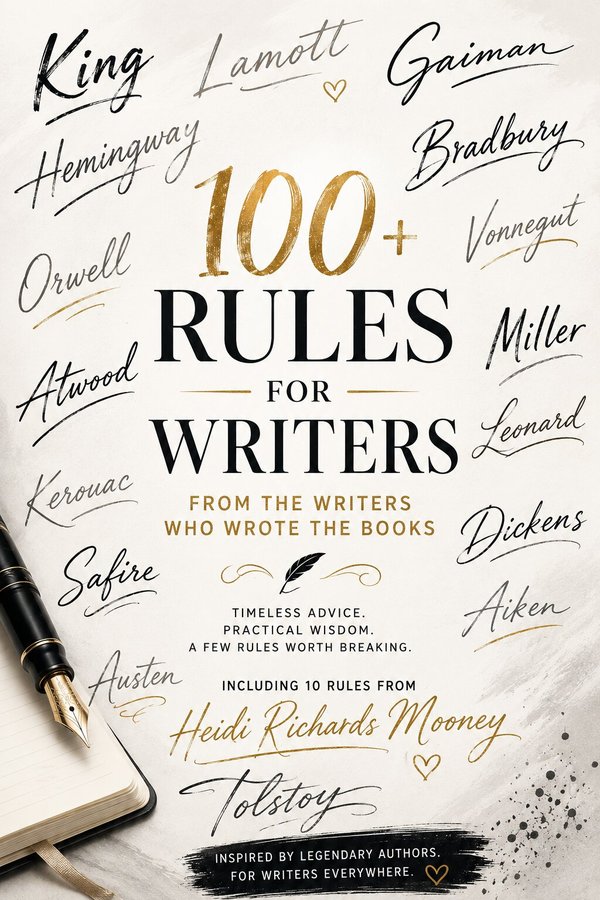
100+ Rules for Writers: From The Writers Who Wrote the Books
by Heidi Richards Mooney
MOST SURPRISING STRUCTURE BOOKY
The judge's reasoning
A good non-fiction book changes one specific thing about your week, and this one is engineered to do exactly that. Mooney's architecture is the real achievement. Ten themed collections of ten rules, each rule built on an identical, learnable frame: the principle, Why It Matters, then a Try This you can do in ten minutes. That repetition is a feature. A writer stuck in Chapter Six can open the book at "Getting Unstuck" and have a task by the next page.
The curation shows judgment. Faulkner gets a pointed disclaimer on "kill your darlings" (the phrase predates him, so the book credits the principle, not the man), and the copyright page is candid that these are interpretations, not direct quotations. That honesty earns trust a lazier quote-collection wouldn't. The book also lets its authorities disagree; the Rules Worth Breaking section sets "Write every day" against the reality that missing Tuesday doesn't revoke your writer's license.
The voice is warm, conversational, and unmistakably Heidi: the recurring "Heidi's Take" sections and the "story underneath the story" idea give the book a personality beyond its borrowed wisdom. The Rule #100 payoff, where the author turns the lens on her own rules and then hands the reader a worksheet to write Rules #101-110, delivers on the title's "+".
Where it is lighter: several attributions are generalized rather than sourced, and the prose leans on short-line rhythm that can feel padded. But as a practical, returnable craft companion, it does what its readers came for.

Judged by Arthur Beaumont — Non-Fiction · Memoir · Business · Self-Help
"A good non-fiction book changes one specific thing about your week."
Supporting passages
"Set a timer for ten minutes. Your only rule: Your fingers must keep moving. You aren't allowed to edit, delete, research, or judge. Just write."
A concrete, immediately actionable exercise that exemplifies the book's Try This format and delivers a real change to a writer's week.
"Simple writing isn't the same thing as simplistic thinking. Sometimes making something simple requires understanding it very deeply."
A compact, well-earned distinction that captures the book's clarity-with-personality argument.
"Don't introduce people by résumé. Introduce them by humanity. Their credentials may explain why we should listen to them. Their humanity is what makes us remember them."
Shows the book's argument structure paying off: an earlier craft principle is reframed through the author's own practice.
Per-axis rubric scores
Every Booky-winning book is scored across all ten craft axes. The award category comes from the top axis; a second axis at or above 75 appears as secondary recognition.
Find out what your book does best.
Submit your book today. Get a real, honest, category-specific Booky — or every dollar back.
Submit Your Book → Screen Another Book