
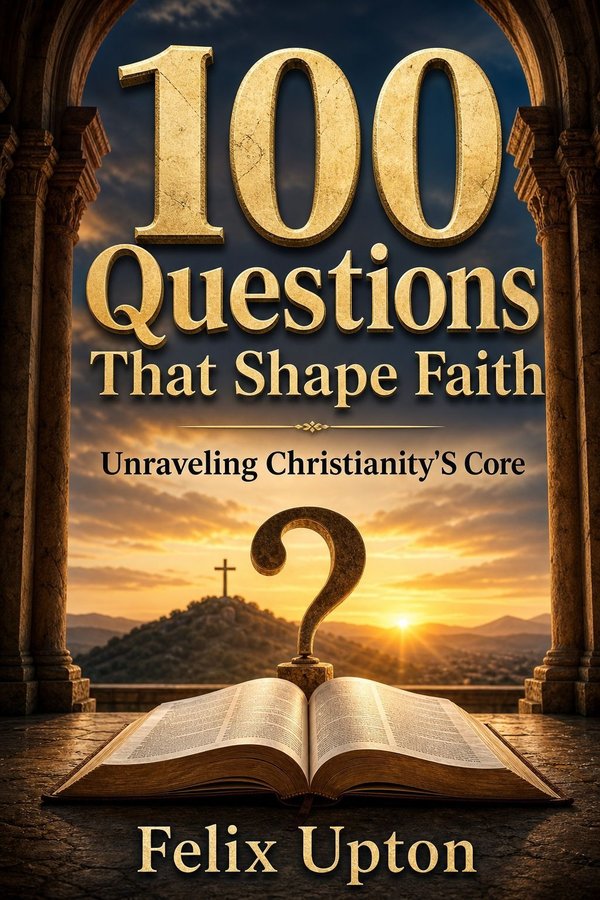
100 Questions That Shape Faith
by Felix Upton
BEST MORAL COMPLEXITY BOOKY
Takes you to this book's Amazon page.
The judge's reasoning
Upton's real skill here is architectural clarity — he takes theological terrain that usually gets muddled (doubt vs. skepticism vs. honest inquiry, relationship vs. rescue vs. renewal, holiness vs. love vs. justice vs. mercy) and lays it out in clean, load-bearing triads that a lay reader can actually hold onto. The line "Advice tells you what you should do; news tells you what has happened" is the book's best sentence: it does in twelve words what a weaker writer would spend a paragraph explaining, and it correctly identifies why the gospel-as-announcement framing matters theologically rather than just rhetorically.
The chapter on the character of God is the strongest sustained argument in this excerpt — Upton resists the temptation to let mercy soften justice or holiness harden love, insisting instead that "mercy is where holiness, love, and justice meet without contradiction." That's a genuinely careful theological move, not a slogan, and it's the kind of distinction that separates a book doing real doctrinal work from one merely reassuring its reader.
Where the book is weaker — prose rhythm tends toward accumulation rather than variation, and nearly every subsection resolves into the same three-beat cadence (name the misconception, hold the tension, restate the orthodox position) — the substance underneath earns its place. This is a book for readers who want the core claims of Christianity argued rather than assumed, and on that ground it delivers something coherent and unafraid of its own hard questions.

Judged by Eleanor "Nell" Whitcombe — Literary Fiction · Prose & Style
"A sentence either earns its breath or it doesn’t."
Supporting passages
"Advice tells you what you should do; news tells you what has happened. Christian faith begins with news."
A precise theological distinction stated with real economy, doing genuine argumentative work rather than décor.
"Mercy is where holiness, love, and justice meet without contradiction."
Refuses to flatten God's attributes into a single mood, holding real tension rather than resolving it cheaply.
"Relationship without rescue can become vague optimism. Rescue without relationship can become a transaction with no intimacy. Renewal without either can become moral effort without grace."
A clean triadic structure that organizes the chapter's whole argument in a single, testable sentence.
Per-axis rubric scores
Every Booky-winning book is scored across all ten craft axes. The award category comes from the top axis; a second axis at or above 75 appears as secondary recognition.
Find out what your book does best.
Submit your book today. Get a real, honest, category-specific Booky — or every dollar back.
Submit Your Book → Screen Another Book